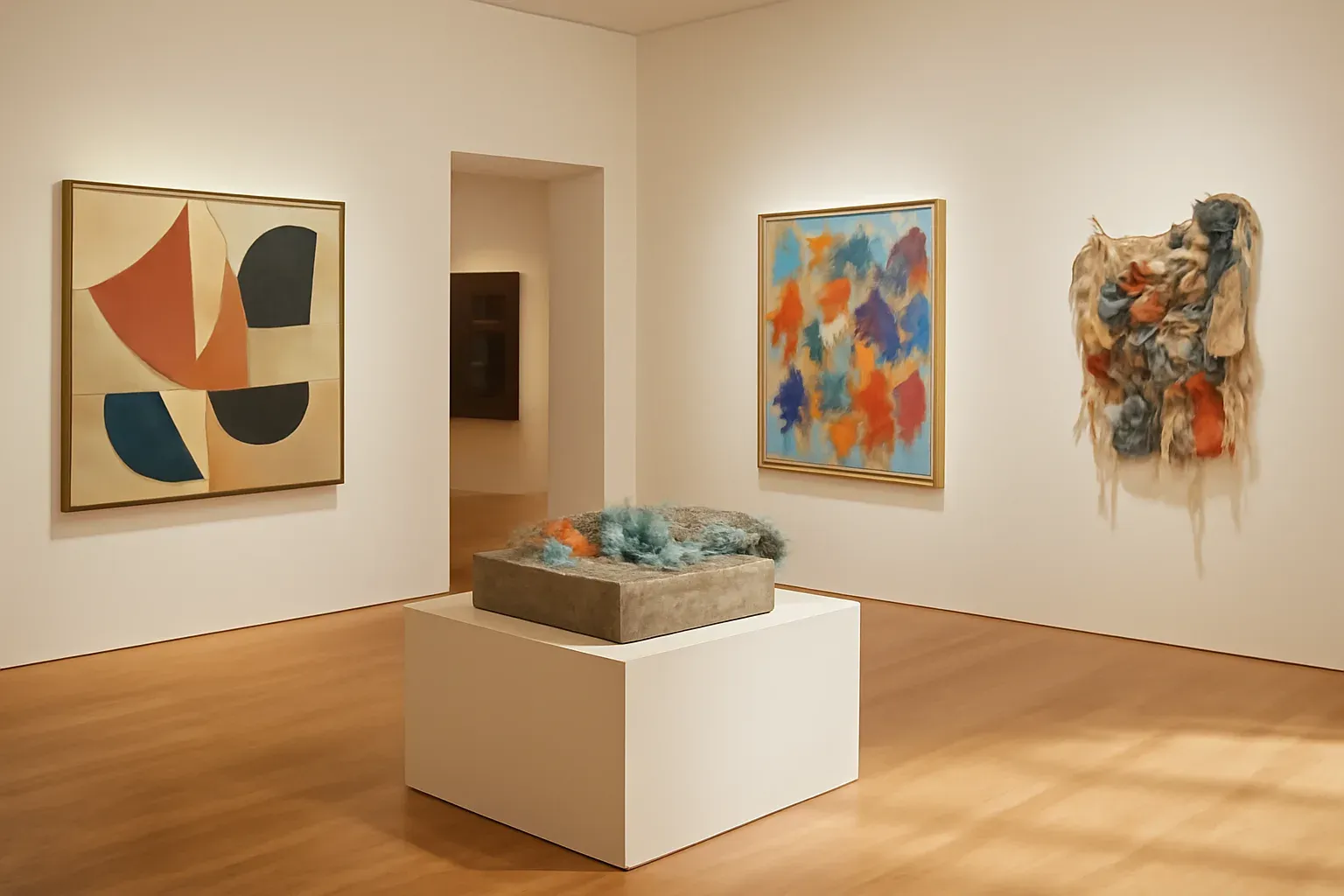
Latin American art often gets grouped into broad labels like “modern” and “contemporary,” but those terms are not interchangeable. For collectors, students, and museum visitors, the distinction matters because it changes how we understand style, historical context, and the questions artists were asking at different moments in time.
In simple terms, modern Latin American art usually refers to art made during the modern period of the early to mid-20th century, when artists were responding to industrialization, nationalism, avant-garde movements, and new ideas about abstraction and identity. Contemporary Latin American art generally refers to work made from the late 20th century to the present, shaped by globalization, migration, post-dictatorship politics, installation, performance, digital media, and cross-disciplinary practice.
The overlap can be messy, and the labels are not universally fixed. Still, understanding the difference helps you read artworks more clearly and place artists in their historical moment.
Why the distinction matters
The words “modern” and “contemporary” are often used loosely in everyday conversation, but in art history they point to different frameworks.
Modern art is typically connected to a period when artists across Latin America were rethinking representation and forging national or regional visual languages. Contemporary art, by contrast, is tied less to a single style than to the present tense: how artists work now, what media they use, and what issues they address.
That means an artwork can be visually modern in spirit without belonging to the modern period, and a contemporary artist can use painting in ways that reference modernism while still being fully contemporary.
What is modern Latin American art?
Modern Latin American art generally spans the early 20th century through roughly the 1960s or 1970s, depending on the country and the scholar. This period includes artists who engaged with European avant-gardes such as Cubism, Surrealism, Constructivism, and abstraction, but who adapted those influences to local realities.
Common features of modern Latin American art
- A search for national or regional identity
- Engagement with abstraction, geometry, and formal experimentation
- Responses to political change, modernization, and urban growth
- Dialogue with European and North American modernism, but not simple imitation
- Strong interest in muralism, figuration, and social themes in many countries
Modern artists often asked how art could represent a society undergoing rapid transformation. In Mexico, muralism became one of the most influential modern movements in the region, with artists such as Diego Rivera, José Clemente Orozco, and David Alfaro Siqueiros creating public works linked to revolution and education. In Brazil, modernism took different forms, including the cultural nationalist energy of the 1922 Semana de Arte Moderna and later movements that mixed European abstraction with Brazilian modern life.
In Venezuela, geometric abstraction became especially important in the mid-20th century, while artists such as Jesús Rafael Soto and Carlos Cruz-Diez pushed perception and movement into new territory. These are modern artists because their key innovations belong to the historical era of modernism, even when their work feels strikingly fresh today.
What is contemporary Latin American art?
Contemporary Latin American art usually refers to art from the late 20th century to the present. It is less defined by one dominant style and more by plurality. Contemporary artists work in painting, sculpture, photography, video, installation, performance, social practice, sound, and digital formats.
Common features of contemporary Latin American art
- Interdisciplinary and media-based practice
- Attention to migration, memory, gender, race, ecology, and power
- Critical engagement with colonial histories and their aftermath
- Global circulation through biennials, museums, galleries, and online platforms
- A flexible relationship to national identity and the art market
Contemporary Latin American art often reflects the complexities of living in a connected, unequal world. Artists may revisit modernist forms, but they usually do so with a critical eye. For example, an artist may use abstraction to address land ownership, or sculpture to explore labor and political violence. Others may work with archives, textiles, or community participation to question how history is preserved and who gets represented.
Contemporary artists such as Doris Salcedo, Tania Bruguera, Cildo Meireles, Adriana Varejão, Miguel Ángel Rojas, and Marisol Escobar’s later relevance in museum discourse illustrate the range of approaches associated with the contemporary field. Their work is not unified by a single style, but by an ongoing engagement with the realities of the present.
The key differences at a glance
1. Historical period
Modern Latin American art belongs mainly to the early and mid-20th century. Contemporary Latin American art belongs to the late 20th century through today.
2. Artistic goals
Modern artists often sought to define a modern visual language and respond to nation-building, industrial change, or political upheaval. Contemporary artists more often investigate memory, identity, inequality, migration, and the circulation of images in a global context.
3. Medium and format
Modern art is strongly associated with painting, drawing, printmaking, muralism, sculpture, and formal abstraction. Contemporary art is more likely to include installation, video, performance, mixed media, photography, and conceptual work, though painting remains important.
4. Relationship to tradition
Modern Latin American artists often broke with academic tradition while also trying to build new cultural foundations. Contemporary artists frequently revisit those modern foundations, sometimes challenging their exclusions or expanding their meanings.
5. Audience and context
Modern art was often shaped by the nation-state, the museum, and public art programs. Contemporary art is shaped by museums, biennials, galleries, residencies, curators, and transnational audiences.
Why the categories can be confusing
The boundary between modern and contemporary is not always clean. Some artists began their careers in the modern period and remained active into the contemporary era. Others are called modern in one context and contemporary in another, depending on museum framing or market usage.
This is especially true in Latin America because art history developed unevenly across the region. The modern period did not arrive everywhere at the same time, and local movements often unfolded alongside political revolutions, dictatorships, economic shifts, and cultural debates that were specific to each country.
So when you see the label, ask:
- When was the work made?
- What artistic problems was the artist responding to?
- Is the work part of a historical movement or a present-day conversation?
- Is the museum or gallery using “contemporary” to mean current, or simply non-academic?
Those questions usually clarify the category better than the label alone.
How collectors and readers can identify each one
If you are looking at an artwork and trying to decide whether it is modern or contemporary, start with context rather than style.
Clues that suggest modern Latin American art
- The work dates from roughly 1900 to 1970s
- It relates to muralism, modernist abstraction, constructivism, or early avant-garde experimentation
- It addresses nationhood, industrialization, or modern life in a historical sense
- It is often documented in the language of art movements and manifestos
Clues that suggest contemporary Latin American art
- The work dates from the late 20th century to now
- It may use installation, performance, video, archival material, or conceptual strategies
- It engages current debates around identity, migration, justice, or ecology
- It often appears in biennials, contemporary galleries, and current museum programs
For collectors, these distinctions also shape how works are interpreted and valued. A modern work may carry the weight of historical significance and movement affiliation, while a contemporary work may be assessed in relation to current curatorial discourse, editioning, and institutional visibility.
A region defined by continuity as well as change
One of the most interesting things about Latin American art is that modern and contemporary practices are deeply connected. Contemporary artists frequently return to modernist forms, but they may do so to revise the assumptions behind them. Modern artists, meanwhile, often laid the formal and conceptual groundwork that contemporary artists later expanded.
Rather than seeing the two categories as opposites, it is more accurate to think of them as part of a longer conversation. Modern Latin American art helped establish the visual languages of the 20th century. Contemporary Latin American art inherits those languages and tests their limits in new conditions.
Further exploration on Latin American Art
If you are building a deeper understanding of the field, explore artist profiles and collection pages that show how these categories work in practice. You can also browse related artists such as Diego Rivera, or Carlos Cruz-Diez, for different historical and conceptual approaches.
For readers interested in broader context, articles on modernism, abstraction, muralism, conceptual art, and biennial culture can help clarify how Latin American art developed across the 20th and 21st centuries.
Understanding the difference between modern and contemporary Latin American art does not just improve terminology. It gives you a better way to read the works themselves: what they inherited, what they challenged, and what they continue to make visible today.