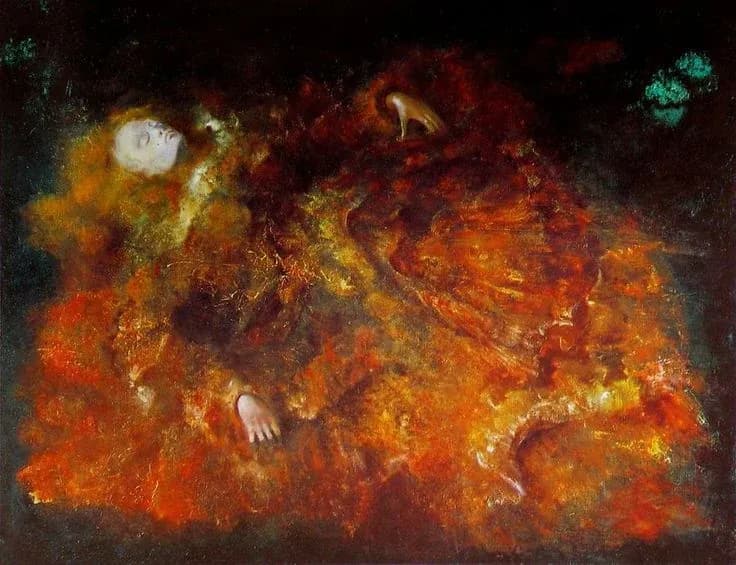
Why Leonor Fini's Women Look Back at You
Open almost any painting by Leonor Fini and you will notice the same thing: the woman in it is not waiting to be looked at, she is doing the looking. Where much of Surrealism turned the female body into a symbol of male desire or unconscious fantasy, Fini painted women who rule, watch, transform and decide. Understanding the female figure in Leonor Fini's art means understanding one of the few Surrealist painters who refused to let women stay objects in someone else's dream.
Fini spent six decades painting powerful, often dominant female figures, sphinxes, and hybrid creatures that reversed the gaze common in Surrealist circles she was frequently grouped with but never formally joined. That reversal, quiet but relentless across hundreds of canvases, is the reason her work still feels startling today, and the reason collectors and curators keep returning to her.
Who Was Leonor Fini?
Leonor Fini (30 August 1907 to 18 January 1996) was an Argentine-Italian surrealist painter, designer, illustrator, and author. She was raised largely in Trieste after her mother fled an unhappy marriage in Buenos Aires, and she was largely self-taught, developing her skills by studying anatomy books and copying works in local museums rather than through formal academic training.
She moved to Milan, the center of the Italian art scene, and quickly fell in with the Novecento group of Surrealists, which included Giorgio de Chirico, and her work was featured in their group show in 1929. By the mid-1930s she had settled in Paris, where she fell in with the circle around André Breton without ever joining it formally, and where her paintings began appearing alongside those of Max Ernst, Salvador Dalí and other figures who would come to define Surrealism in the public imagination.
Her international breakthrough came in 1936, when her work rose to prominence following her inclusion in the pivotal exhibition Fantastic Art, Dada, Surrealism at New York's Museum of Modern Art. Outside painting, Fini designed costumes and sets for theater, opera and film, illustrated books by Jean Genet and the Marquis de Sade, and famously sculpted the curvy glass bottle for Elsa Schiaparelli's 1937 perfume "Shocking," a design still cited as one of the most recognizable objects in 20th-century perfume history.
Reversing the Surrealist Gaze: How Fini Painted Women
The Surrealist movement, for all its radicalism, often treated women as muses, mediums or erotic symbols rather than as creative agents. Like the Surrealists, Fini's work was inspired by the unconscious mind, however she broke from femme fatale depictions of women as symbols of the erotic and creative, exploring the power dynamic between men and women by inverting the canon.
In practice, that inversion shows up again and again in specific compositional choices:
Women are seated, standing or reclining in positions of command, often above or looking down on male figures who are nude, sleeping or subordinate.
Female bodies are sexualized, but the sexuality belongs to the woman herself rather than being offered up for a viewer's consumption.
Animals, especially cats and sphinxes, appear as extensions of female authority rather than as tamed companions.
Many of Fini's paintings featured women in positions of power or in very sexualized contexts, and Madonna used the imagery of one of her exhibits, Le Bout du Monde, in her 1994 video "Bedtime Story." That a pop icon built on controlling her own image would reach for Fini's imagery decades later says something about how contemporary her ideas about female power still read.
Sphinxes, Goddesses and Hybrid Creatures
The sphinx became Fini's signature figure, a half-woman, half-animal presence that let her collapse the boundary between human intelligence and instinctual, animal force. Art historian Mathew Gale has argued that "Fini located herself within a specifically female hermetic tradition of an originary and powerful Great Goddess." In canvases built around ruined temples, cracked stone and crumbling architecture, Fini's compositions positioned the feminine as the locus of spiritual authority, treating the female body as something ancient and commanding rather than fragile or decorative.
Power, Desire and the Female Body
Fini's paintings are frequently erotic, but the eroticism runs in an unusual direction for the period. Across a long career, her canvases journey between the pains of despair and the serenity of enlightenment while remaining polished with eroticism at every extreme. Men in her work are often the ones exposed, vulnerable or decorative, a deliberate mirror of the way Surrealist painters like Ernst or Paul Delvaux typically treated women. Her exploration of female sexuality and identity unfolded largely through Gothic paintings, dense with candlelight, drapery, skulls and masks, that read as much as psychological theater as portraiture.
Why Fini Refused the Surrealist Label
It is easy to call Fini a Surrealist today, but she resisted the term throughout her life, and the reasons matter for understanding her work. The iconoclastic Leonor Fini was arguably the most ferociously and heroically independent woman artist of the 20th century, and she herself never accepted the label of "woman artist," likewise never considering herself a Surrealist.
Part of the friction was personal and political. She distrusted Breton's authority over the group and its rules about who counted as a "real" Surrealist, a skepticism rooted partly in how the movement's leadership treated the women around it. Fini wanted the freedom to paint mythic, commanding female figures on her own terms, without having to answer to a manifesto written mostly by men. You can read more about her position within, and apart from, the movement on Making Queer History's profile of the artist, or explore her full career on The Art Story's artist page.
Key Works to Know
Work | Year | Why It Matters |
|---|---|---|
The Shepherdess of the Sphinxes | 1941 | A commanding woman surrounded by sphinx-like creatures, reversing typical shepherd/flock hierarchies |
The Alcove: An Interior with Three Women | 1939 | Three women occupy an intimate, theatrical interior with no male presence at all |
Le Bout du Monde | 1949 | Later referenced by Madonna, an image of feminine mystery at the edge of the known world |
In the Tower (Self-Portrait with Constantin Jeleński) | 1952 | A rare double self-portrait, now Fini's auction record holder |
These paintings, along with dozens of related works, form the visual argument that runs through her career: women as sphinxes, priestesses, guardians and equals, never as passive muses.
Fini's Place in Today's Museums and Market
Institutional recognition of Fini has grown considerably in recent years. Her work is held by institutions including the Peggy Guggenheim Collection in Venice and Tate Modern in London, and a catalogue raisonné of her oil paintings was published in 2021, authored by Fini experts Richard Overstreet and Neil Zukerman. Recent gallery and museum attention includes a dedicated show, presented at the Mart in Rovereto from July 16 to November 5, 2023, titled Leonor Fini Fabrizio Clerici: Insomnia, curated by Denis Isaia and Giulia Tulino from an idea by Vittorio Sgarbi, alongside a 2024 retrospective at Paris's Galerie Minsky.
The auction market has caught up too. In November 2025, Fini's auction high became In the Tower (Self-Portrait with Constantin Jeleński), a 1952 self-portrait that sold for USD 2,515,000 at Christie's New York, setting a new record for the artist. Reporting on the same sale noted that the painting bested the $2.1 million set at Sotheby's in May 2021, a clear sign that collector demand for her work, and specifically for her images of female authority and selfhood, keeps rising. You can read the full sale details in The Art Newspaper's coverage of the November 2025 sales.
Where to See and Collect Leonor Fini Today
Because Fini worked across painting, illustration, costume design and set design, her market is unusually varied: oil paintings command the highest prices, while works on paper, book illustrations and theatrical designs remain more accessible entry points for new collectors. Specialist galleries representing her estate, along with major auction houses, are the most reliable sources for authenticated works, particularly given the 2021 catalogue raisonné now used to verify attribution.
FAQ
Was Leonor Fini actually a Surrealist? She showed alongside the Surrealists and is now classified within the movement by most museums and historians, but she herself never accepted the label of "woman artist," and likewise, never considered herself a Surrealist, largely over disagreements with André Breton's leadership.
What does the sphinx symbolize in Fini's paintings? The sphinx let Fini merge human intellect with animal instinct in a single female body, presenting women as ancient, powerful and self-possessed rather than fragile or purely decorative.
Where can I see Leonor Fini's work in person? Her paintings are held in major collections including the Peggy Guggenheim Collection and Tate Modern, and she has been the subject of recent exhibitions in Italy and France, including shows in Rovereto in 2023 and Paris in 2024.
Why has interest in Fini grown recently? A 2021 catalogue raisonné clarified authentication for her oil paintings, and a wave of reassessment of overlooked women Surrealists has pushed prices up, culminating in a new auction record of over $2.5 million in November 2025.
How did Fini's depiction of women differ from other Surrealists? Instead of using the female body as a symbol of male unconscious desire, she explored the power dynamic between men and women by inverting the canon, painting women as the ones who command the frame.