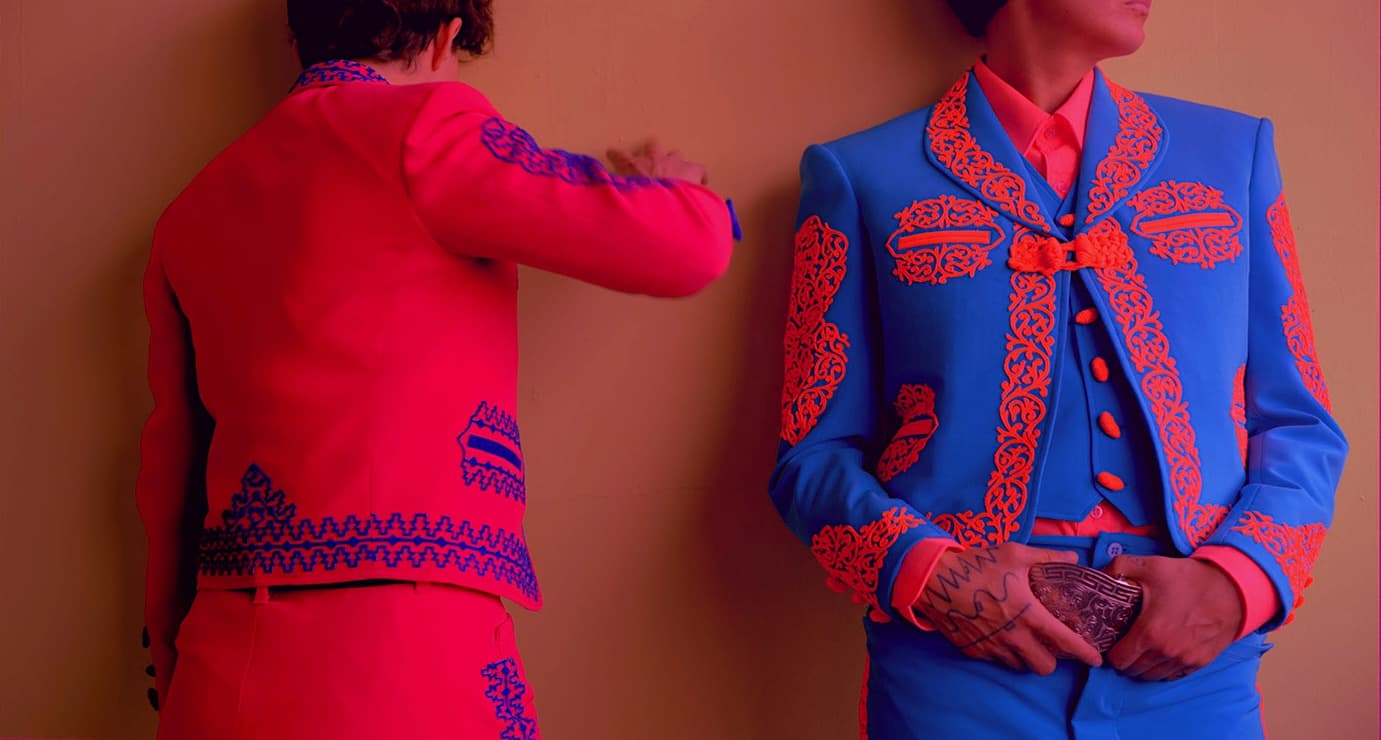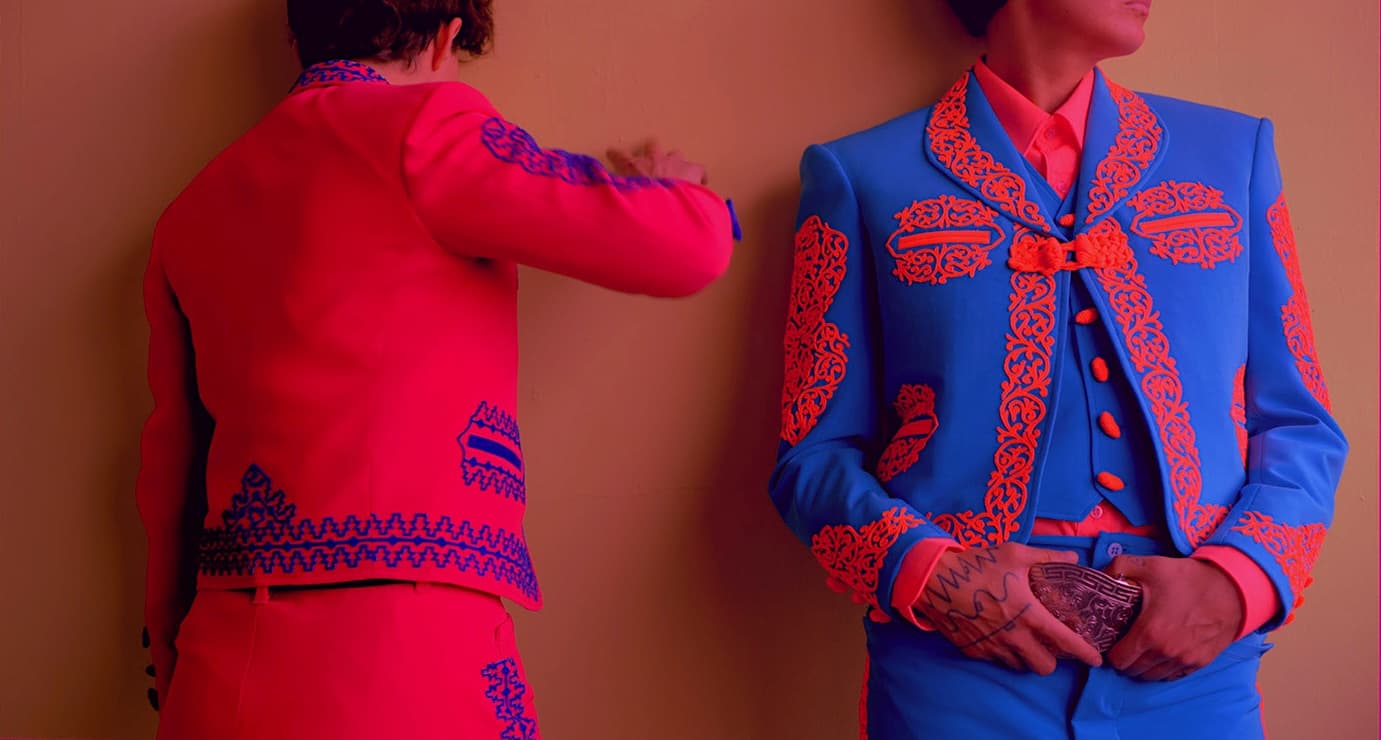
The charro, Mexico's ornately dressed horseman of stage and screen, was built to project one kind of masculinity: stoic, armed, unmistakably straight. Painter Ana Segovia takes that same figure, soaks him in electric pink and acid yellow, slices the frame so a torso or a hand fills the whole canvas, and lets the macho icon mean something entirely different. Ana Segovia's charro paintings have become one of the most talked-about bodies of work to come out of Mexico City in the past decade precisely because they do not reject the Golden Age of Mexican cinema. They sit inside it, rewatching it frame by frame, until its contradictions show.
Who Is Ana Segovia
Born in Mexico City in 1991, Segovia earned a BFA from the School of the Art Institute of Chicago in 2015 before returning home, where she has widely exhibited. Her relationship to cinema is not academic distance, it is inheritance. Ana Segovia comes from a family of filmmakers and initially wanted to become a filmmaker herself. In interviews she has described growing up on archive reels from Mexico's cinematic Golden Age because members of her own family helped make that era, including pioneering work on the ranchero comedy genre that put the charro on screen in the first place.
A teacher's suggestion redirected that cinematic instinct toward paint. As Segovia recounted to the Louisiana Channel, turning her elaborate storyboards into canvases changed everything about how she worked, and she has said plainly that she makes art to picture things that do not yet exist. By 2020, Artsy had already flagged her as one of the artists reshaping Mexico City's scene, and her work now sits in institutional collections including the Pérez Art Museum Miami (PAMM) and Alumnos 47 in Mexico City. You can see the through-line of her career on her artist page, where paintings, video and performance all orbit the same obsession: the charro as a national myth worth taking apart.
The Charro as Mexico's Original Macho
To understand what Segovia is doing, it helps to know what she is doing it to. The Golden Age of Mexican cinema, roughly the 1930s through the 1960s, produced the ranchera genre: musical comedies set on haciendas, full of horses, mariachi songs and love triangles. Films like Allá en el Rancho Grande and Los Tres García turned the charro, a landowning horseman in a tightly tailored, silver-buttoned suit, into a national archetype of masculinity, the ideal man who sings, fights and never shows weakness.
Segovia has spent years rewatching these films as source material. Working from repeated viewings of films from the Golden Age of Mexican Cinema like Allá en el Rancho Grande (1936) and Los Tres García (1946), she builds a personal method for taking apart masculinity itself in that period's performances. The charro she paints is not a villain. It is, as one critic put it, the aristocratic or landed version of the Mexican cowboy who famously wears highly ornate, formal suits, a figure Segovia clearly finds as seductive as she finds suspect.
Queering the Charro: Segovia's Visual Strategy
Neon Color as Disruption
The first thing most viewers notice about a Segovia painting is the color. Where the original films used naturalistic, often sepia-toned palettes, Segovia drenches the same compositions in fluorescent pink, acid yellow and electric blue. At the Venice Biennale, she adapted her 2021 show into the video Aunque Me Espine la Mano, depicting ambiguous charro figures in a neon pink, campy space. The effect is camp in the technical sense: exaggeration that exposes artifice. A macho pose painted in bubblegum pink stops reading as natural and starts reading as costume, which is exactly the point.
The Art Newspaper summarized the strategy well, describing Segovia's output as winking, neon reinterpretations of the Mexican cowboy archetype that bend and break preconceived notions of normative machismo, translating film stills from Mexico's cinematic Golden Age into an unabashedly queer new language. The palette does not just decorate the charro, it destabilizes him.
Cropped Framing and the Fragmented Body
The second signature move is the crop. Segovia rarely paints a charro head to boot. Instead she zooms into a hand resting on a hip, a belt buckle, the curve of a hat brim, a torso cut off at the neck. This fragmentation borrows directly from cinema's own grammar: the close-up, the pan, the freeze frame. One recent canvas, Through Mario's Perspective, stretches over thirteen feet wide, forcing the viewer's eye to travel across a panoramic, cropped scene the way a camera would track a shot.
By isolating a gesture instead of showing a whole body, Segovia strips the charro of narrative context and turns him into pure form and surface, which is where desire tends to live. Art historian Christian Gómez has noted the formal debts this approach owes to painters working in a similarly flattened, pop-inflected register, pointing out the formal influence of artists such as David Hockney and Dana Schutz on Segovia's canvases. The crop is also, functionally, an editing choice: Segovia decides what the Golden Age showed us and what it conveniently left out.
Inside the Key Works and Shows
La Faena and the Early Interventions
Segovia's public reckoning with machismo took a literal stage in February 2020, when, during Mexico City's art week, her intervention at La Faena, a bullfighting-themed cantina, set the stage for her deconstruction of hyper-masculine tropes. The venue itself, soaked in bullfighting nostalgia, was as much the subject as any single canvas.
Aunque Me Espine la Mano at Venice
That same body of work traveled to the 2022 Venice Biennale as a video installation, bathing ambiguous charro figures in the pink, campy space described above. The piece confirmed Segovia's work could move fluidly between painting and moving image without losing its central argument about performance and masculinity.
Pos' Se Acabó Este Cantar
A later exhibition dug further into specific film texts, with Segovia using close study of Allá en el Rancho Grande and Los Tres García to isolate the gestures and costumes that built the charro's mythology in the first place, then recomposing them in her own visual language.
MOCA Focus and the Gay Cowboy Movie That Never Existed
Segovia's most ambitious project to date is MOCA Focus: Ana Segovia, her first solo museum exhibition in the United States, on view at MOCA Grand Avenue in Los Angeles. The artist, a direct descendent of major players in the Golden Age of Mexican Cinema, an era spanning from the early 1930s to the late 1960s, has used film stills drawn mostly from this tradition as a source for her paintings. For this show, she shifted her gaze north and forward in time, turning to Roger E. Alamos's I've Been Meaning to Tell You (1983) as her source material, a film Segovia invented entirely, complete with a fictional director, to imagine the openly gay cowboy movie Hollywood never made. As she told The Art Newspaper, the project came from a simple wish: "I wanted my gay cowboy 80s movie."
Beyond Mexico: Córdoba and New York
Segovia's method travels well because the charro has cousins everywhere nationalist cinema invented a macho hero. In Spain, her exhibition Me duelen los ojos de mirar sin verte at the Centro de Creación Contemporánea de Andalucía (C3A) in Córdoba turned the same technique on Spanish cinema, drawing particular inspiration from the dancer and singer Lola Flores and the film Pena, penita, pena, with a chromatic use of ochre, acidic pink and yellow that suggests a certain baroqueness familiar from her Mexican work.
In New York, her first solo show at kurimanzutto, The Office of Inter-American Affairs Presents, pushed the project further, with cinema serving as both the exhibition's historical point of departure and one of its defining formal strategies. The show included vertical compositions depicting the mountainous landscapes of Chilean Patagonia in pastel shades of pink, green, blue and orange that evoke the sensory experience of the territory rather than emphasizing realism, proof that Segovia's interest in cinematic myth-making extends past Mexico's borders.
Why Segovia's Work Matters Now
Segovia's paintings land at a moment when collectors and institutions are actively reassessing how national identity and gender were manufactured on screen, not just in Mexico but across Latin America and beyond. Her paintings subvert the heteronormativity of popular imaginaries, revisiting mythical scenes and figures from film and sports to reconfigure their hegemonic role as idealized models of masculinity. That makes the work legible to a broad audience: you do not need to know Mexican film history to feel that something is being gently, insistently rearranged.
For collectors browsing Latin American contemporary painting, Segovia represents a rare case of an artist whose formal language, neon color, cinematic cropping, is immediately recognizable and whose conceptual project, the deconstruction of machismo through its own source material, keeps deepening with each exhibition. Readers can track her works through Ana Segovia's artist page.