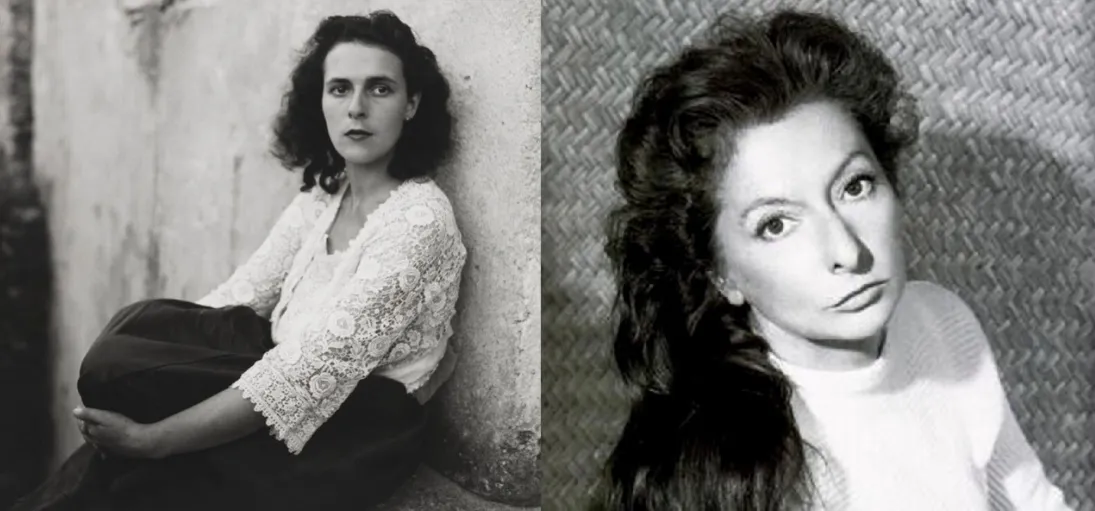
Remedios Varo painted with the precision of a watchmaker and the mind of an alchemist. Leonora Carrington painted with the restlessness of a storyteller raised on Celtic folklore and Mexican myth. Both women were refugees who found their voice in the same city, in the same decade, often in the same room, yet their canvases are rarely mistaken for one another once you know what to look for. Understanding Remedios Varo vs Leonora Carrington is really a study in two different relationships to science, symbolism and the self.
This guide breaks down their origins, techniques, recurring imagery and current market standing, so collectors and museum visitors can tell the two apart at a glance and appreciate why each artist matters on her own terms.
Two Refugees Who Became Mexico City's Surrealist Core
Fleeing the trauma of World War II, the Spanish painter Remedios Varo and the British artist Leonora Carrington both found refuge in Mexico City during the 1940s. They had met in Paris and became close friends after finding refuge in Mexico City. That friendship, formed among fellow exiles, is the reason their work is so often discussed together, and so often confused by newcomers to Surrealism.
In 1941, with her second husband, the Surrealist poet Benjamin Péret, Varo fled Vichy France for Mexico. Carrington arrived around the same period after her own escape from occupied Europe and a breakdown documented in her memoir. They were both foreigners: Remedios was born in Girona, Catalonia, Spain, while Leonora was born in Lancashire, in northwestern England. Settling in the Colonia Roma neighborhood, they built a support network with other exiled artists that let both women paint full time for the first time in their lives.
Different Starting Points: Spain's Academies vs. English Rebellion
The two women arrived at Surrealism from opposite directions. Varo had academic training as a young woman in Spain, at a time when few women were admitted to formal art schools, and she carried that discipline of accurate drafting and perspective into every later canvas. In the 1930s she lived in Madrid, Barcelona, and Paris, while involved in what seem to have been amicably polygamous relationships within the Surrealist circle around André Breton.
Carrington's path was less conventional. Her biography is colorful, including a romance with the older artist Max Ernst, an escape from the Nazis during World War II, mental illness, and expatriate life in Mexico. She came from an upper-class English family that expected a society debutante, not a painter, and her rejection of that world shows up repeatedly in her imagery of flight, transformation and animal familiars.
Though she never returned to her homeland, Varo kept her Spanish citizenship, unlike her friend Leonora Carrington, who was naturalized as a citizen of Mexico. That single biographical detail hints at a larger truth: Varo remained, in spirit, a European technician transplanted to Mexico, while Carrington became something closer to a Mexican artist who happened to be born in England.
Signature Styles: Alchemy and Machines vs. Myth and Metamorphosis
Remedios Varo's Meticulous Cosmos
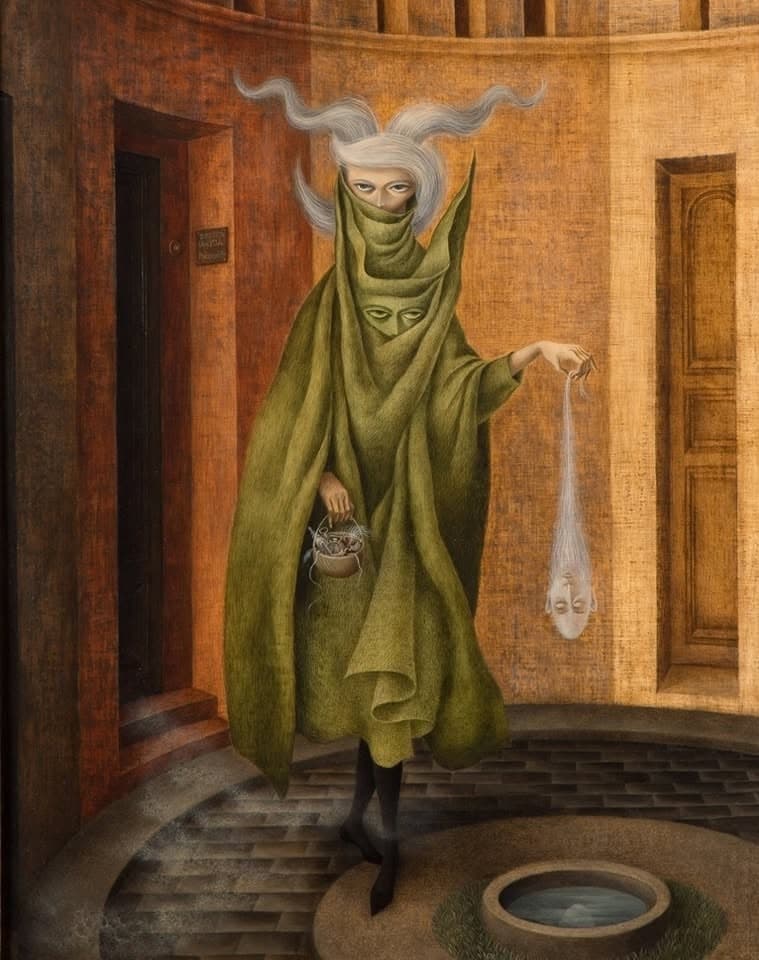
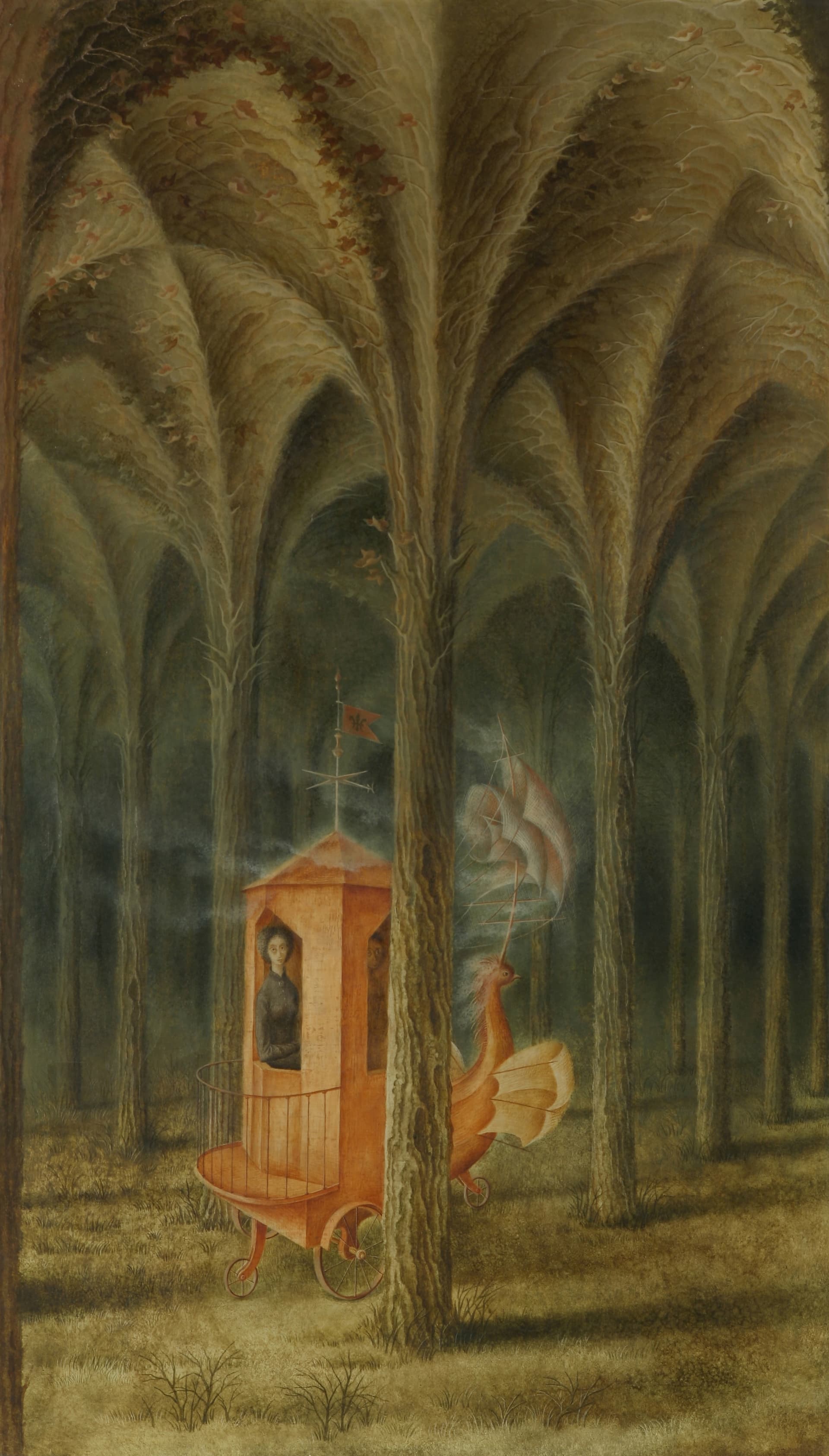
One of the most distinctive features of Remedios Varo's paintings is the seamless way she combined scientific imagery with occult symbolism. Her figures are often androgynous travelers, alchemists or clockmakers operating impossible machines inside tower rooms, rendered with a fine, almost miniaturist brush. The National Gallery of Art describes her work as combining ideas of the occult, mysticism, psychoanalysis, astrology, esotericism, and science, blending nature with the built environment and featuring characters and open-ended narratives that reflect her life and times.
Her undisputed masterpiece, La creación de las aves (The Creation of the Birds, 1957), shows a bird-headed figure channeling starlight through a violin-like instrument to paint living birds into being. The painting hangs in the Museo de Arte Moderno in Mexico City. The Art Institute of Chicago has written extensively on how this single image condenses her entire method: science and sorcery as the same creative act.
Leonora Carrington's Myth and Menagerie
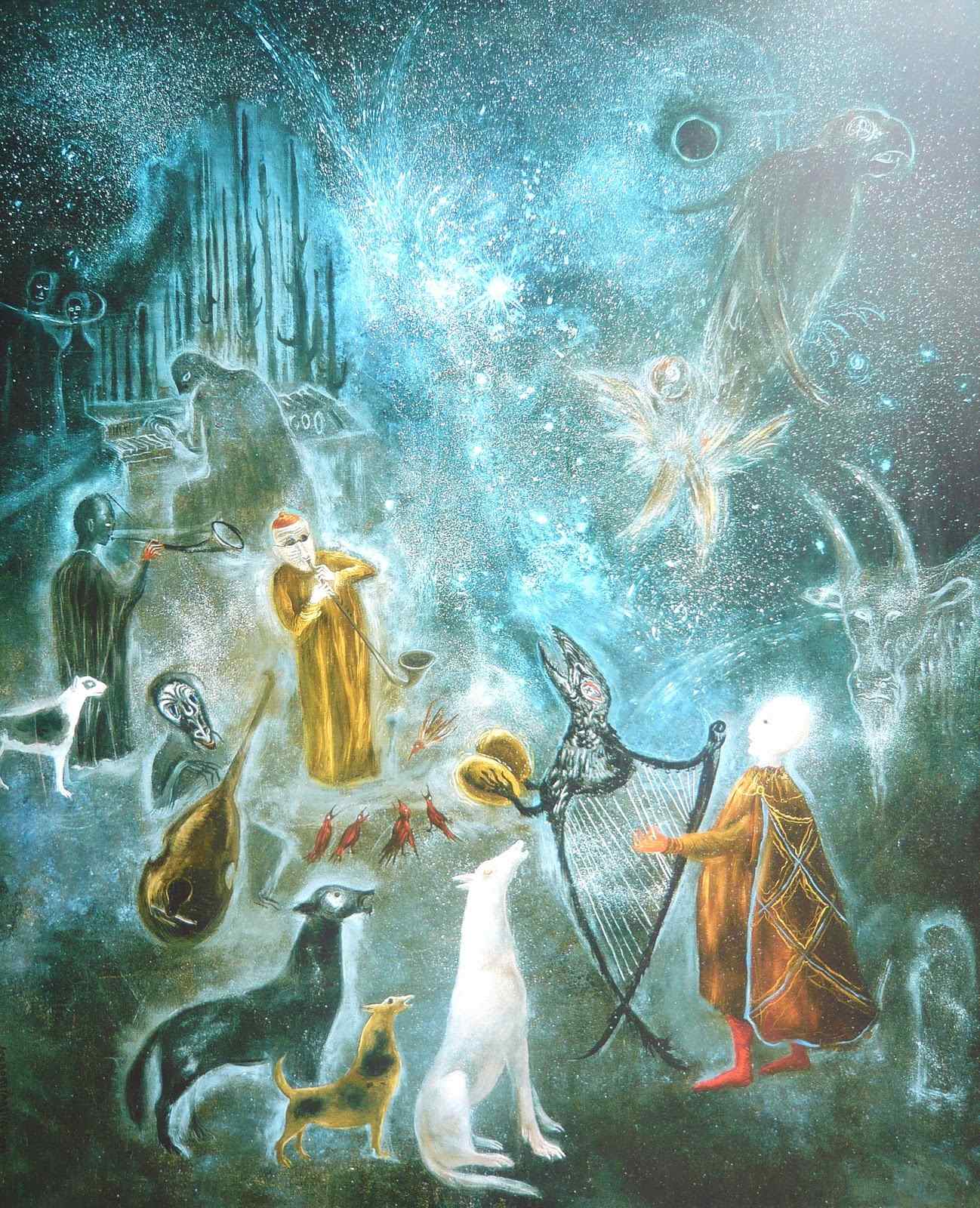
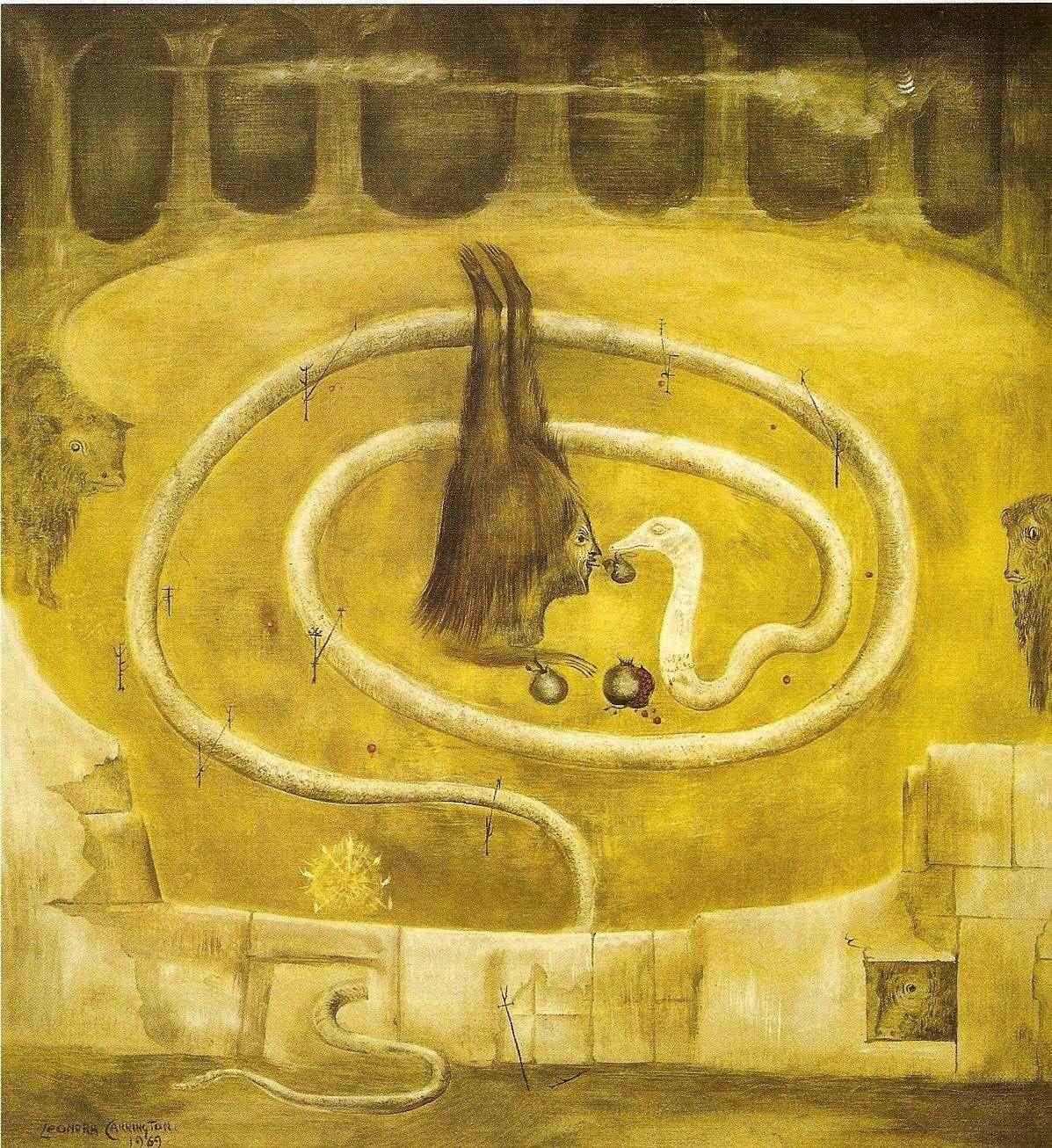
Carrington's paintings draw less on laboratory precision and more on folklore, Catholic ritual and Mexican legend woven together. Amid the machismo of Surrealism, Leonora Carrington painted dreamlike scenes that made space for feminine rhetoric within the movement, incorporating regional myths and Catholic imagery. Hybrid creatures, hyenas, horses and witch-like matriarchs recur throughout her canvases as stand-ins for the artist herself; her early Self-Portrait from around 1937-1938 depicts the artist in a domestic interior, extending an open hand to a female hyena.
Carrington was also a working writer, producing short stories and novels alongside her paintings, including her celebrated 1976 novel The Hearing Trumpet. She was also a founding member of the women's liberation movement in Mexico during the 1970s, and her later career included large bronze sculptures that extended her painted mythology into three dimensions.
Key Works Side by Side
Remedios Varo | Leonora Carrington | |
|---|---|---|
Signature work | La creación de las aves (1957), Museo de Arte Moderno | The Giantess (The Guardian of the Egg), c. 1947 |
Recurring subject | Alchemists, clockmakers, androgynous travelers | Hybrid animals, witches, matriarchal figures |
Core influence | Science, alchemy, Catalan Catholicism | Celtic folklore, Mexican myth, Catholic ritual |
Also worked in | Commercial illustration | Fiction, memoir, bronze sculpture |
Carrington created The Giantess around 1947 in Mexico City, after becoming a resident of Mexico in 1942, and the picture's egg-cradling central figure is widely read as her answer to Varo's bird-creating alchemist, two women imagining creation on their own terms rather than borrowing from the male Surrealists around them.
How the Market Treats Them Today
Their reputations, nearly equal during their lifetimes within their small émigré circle, have diverged sharply at auction. Varo's Revelación (also titled El relojero), from 1955, set a new auction record when it sold for $6.22 million at Christie's New York in May 2025, edging past her prior record set by Armonía (Autorretrato Sugerente) in 2020.
Carrington's prices have risen far more dramatically. Her 1945 painting Les Distractions de Dagobert set a new auction record, selling for $28.48 million at Sotheby's New York, 700 percent above her previous record sale. The work sold well above its estimated $12 million to $18 million, smashing her previous record of $3.3 million set at Sotheby's in 2022. Carrington is now among the most valuable Surrealist artists at auction of either sex, while Varo, though consistently strong, trades at a fraction of that level.
Where to See Their Work in Person
Visitors to Mexico City can see Varo's major canvases, including La creación de las aves, at the Museo de Arte Moderno, and can tour Carrington's former home and studio at the Casa Estudio Leonora Carrington in Colonia Roma, the same neighborhood where both women once lived among their exiled community. In the United States, the National Gallery of Art's recent acquisitions have begun building a stronger Varo presence north of the border.
FAQ
Were Remedios Varo and Leonora Carrington actually friends, or is that a myth? They were genuinely close. They met in Paris and became close friends after finding refuge in Mexico City, where they supported each other financially and creatively for over two decades until Varo's sudden death in 1963.
Which artist is more valuable at auction today? Carrington, by a wide margin. Her auction record stands at $28.48 million, compared with Varo's record of $6.22 million, though both figures have climbed sharply in the past decade as collector interest in women Surrealists has grown.
Did either artist have formal art school training? Varo studied painting formally in Spain as a young woman, one of relatively few women admitted to such programs at the time. Carrington's training was less conventional, built through private academies in London and her immersion in the Paris Surrealist circle after meeting Max Ernst.
What is the easiest visual clue for telling their paintings apart? Look at the brushwork and subject. Varo's scenes favor tight, engineered detail: gears, towers, instruments, cosmic diagrams. Carrington favors looser, more theatrical scenes built around hybrid animals, cauldrons and ritual, closer to a folk tale than a science diagram.
Why are they so often exhibited together? Beyond their friendship, both women reshaped Surrealism from the margins of a movement dominated by men, turning the female body and female authorship into subjects rather than objects. Their shared Mexico City years make joint exhibitions a natural way to show two answers to the same historical moment.