Remedios Varo
Spain, b. 1908, d. 1963
Remedios Varo y Uranga was a Catalan surrealist painter born on December 16, 1908. She became one of the most distinctive artists associated with surrealism in the twentieth century, developing a visual language filled with mystery, imagination, science, magic, architecture, and dreamlike transformation. Although she was born in Spain and lived in several European cities, her mature career unfolded in Mexico, where exile gave her both refuge and the conditions to create her most celebrated work.
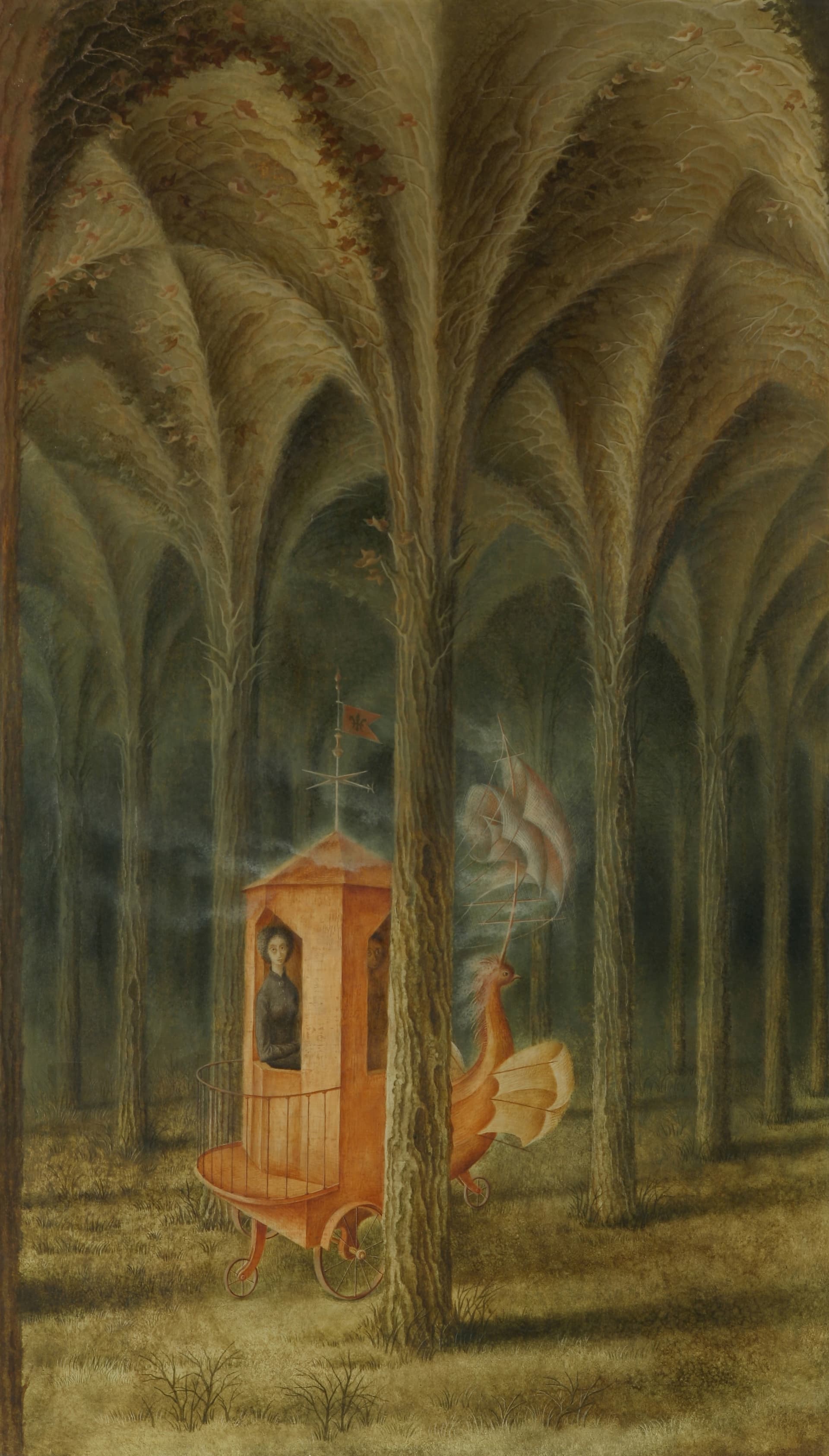
Varo grew up in an environment that encouraged observation and technical precision. Her father, an engineer, exposed her to drawing, machinery, perspective, and the logic of construction. These early influences can be seen throughout her paintings, where strange machines, delicate instruments, invented vessels, towers, laboratories, and architectural interiors often appear. Even when her images are fantastical, they are carefully built. Her imaginary worlds feel precise, controlled, and internally consistent.
She trained in art in Spain and became part of the European avant garde during a period of political and cultural upheaval. Surrealism, which explored dreams, the unconscious, unexpected associations, and alternative realities, offered Varo a powerful language for her imagination. Yet her work should not be seen as merely following a movement. She developed a deeply personal version of surrealism, one that was more intimate, spiritual, and psychologically charged than theatrical. Her paintings often feel like private visions, as if the viewer has entered a secret room where transformation is already underway.
The Spanish Civil War and the rise of fascism forced Varo into exile. Like many artists and intellectuals of her generation, she moved through different European cities before eventually settling in Mexico. This displacement was painful, but it also reshaped her artistic life. Mexico became a major center for exiled European artists, writers, and thinkers, while also offering its own rich traditions of mythology, mysticism, craft, and visual culture. In this environment, Varo found space to develop her mature style.
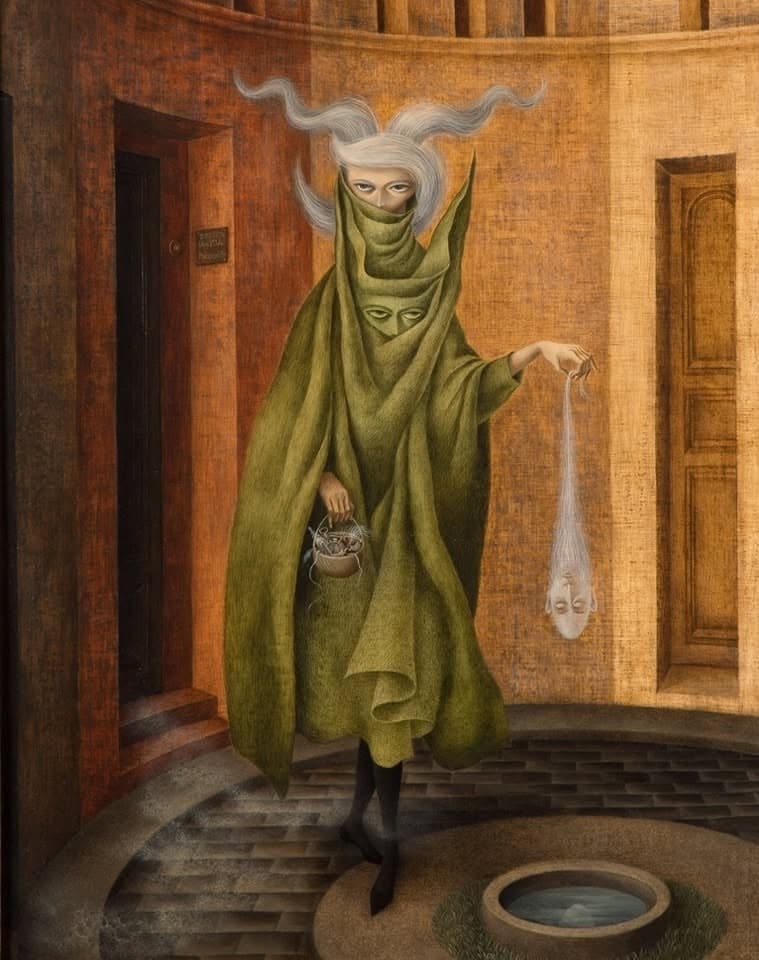
Her paintings often feature solitary figures engaged in mysterious tasks. These figures may be travelers, alchemists, musicians, scientists, magicians, or seekers. They appear inside narrow rooms, cosmic landscapes, forests, towers, or dreamlike cities. Their actions are rarely simple. They seem to be searching for knowledge, performing rituals, escaping confinement, or transforming the world through hidden forces. Varo’s art often suggests that reality is not fixed, but layered, symbolic, and full of invisible connections.
A recurring theme in her work is transformation. Human beings merge with animals, machines, stars, wind, or music. Rooms become vessels. Clothing becomes architecture. Scientific tools become magical instruments. This blending of categories reflects Varo’s interest in alchemy, mysticism, psychology, and the unseen structures of existence. Her art does not separate reason from imagination. Instead, it suggests that the rational and the magical can coexist. Varo’s work also has a strong feminist dimension, even when it is subtle. Many of her female figures appear as thinkers, creators, travelers, and agents of their own inner journey. They are not passive subjects. They are inventors of meaning, moving through strange worlds with discipline and purpose.
Remedios Varo died in Mexico on October 8, 1963. Although her life was marked by exile and displacement, her paintings created a universe entirely her own. Today, she is remembered as one of the great surrealist painters of the twentieth century, an artist whose work joins technical precision with poetic mystery, and whose images continue to feel intelligent, haunting, and profoundly original.
Represented By
Artworks by Remedios Varo