Carlos Cruz-Diez
Venezuela, b. 1923, d. 2019
Carlos Cruz-Diez was a Venezuelan artist born in 1923 in Caracas and one of the most influential figures in kinetic and optical art.
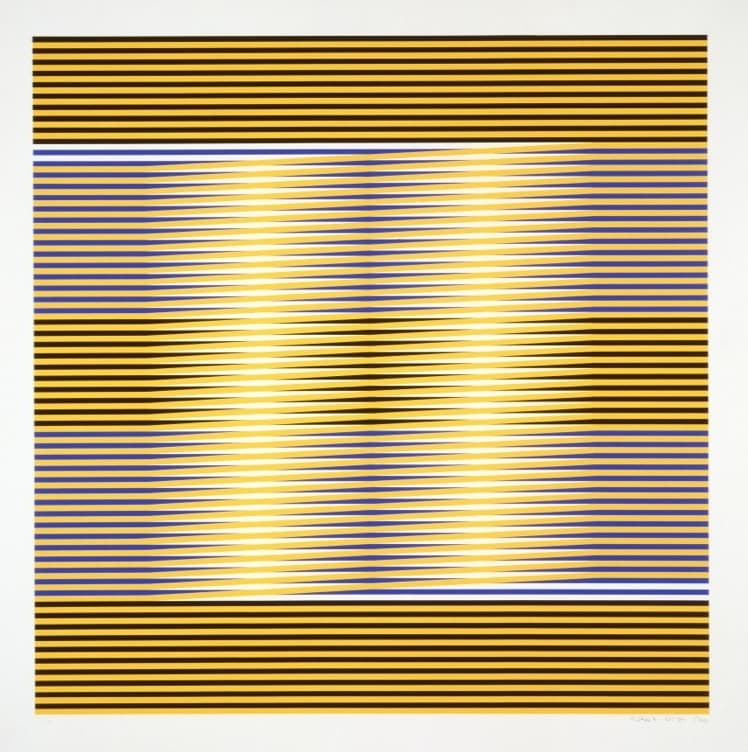
His work transformed the understanding of color, treating it not as a secondary element used to describe form, but as an independent, evolving phenomenon that exists in space and time. Over a career that spanned more than six decades, he developed a rigorous and innovative practice centered on perception, movement, and the active participation of the viewer.
He studied at the Escuela de Artes Plásticas y Aplicadas in Caracas, graduating in 1945. His early career included work as an illustrator and graphic designer, alongside figurative painting that often reflected social themes. However, by the mid twentieth century, he began to move away from representation and toward abstraction, influenced by modernist ideas and a growing interest in the structural and perceptual aspects of visual art.
A major turning point came when Cruz-Diez relocated to Paris in 1960. There, he became part of an international community of artists exploring perception, movement, and the relationship between art and viewer. While often associated with the kinetic art movement, his approach remained distinct. Rather than focusing on mechanical movement, he concentrated on the behavior of color itself, exploring how it changes depending on light, position, and the viewer’s movement through space.
Throughout his career, Cruz-Diez developed several key bodies of work that became central to his research. Among these are the Physichromies, Chromosaturations, Chromointerferences, and Induction Chromatique series. Each of these investigations focused on the instability of color and its ability to shift in response to environmental conditions. His works are not fixed images. Instead, they are dynamic experiences that change as the viewer moves, creating a continuous interaction between the artwork and the observer.
Cruz-Diez believed that color could exist independently of form and narrative. He approached it as a physical reality, capable of transforming perception and redefining space. In many of his installations, color appears to detach from the surface and occupy the surrounding environment, creating immersive experiences that blur the boundaries between artwork and viewer. This idea positioned his work at the forefront of postwar abstraction and contributed to a broader rethinking of how art is experienced.
His practice extended across multiple mediums, including painting, printmaking, sculpture, and large scale installations. He was particularly interested in integrating art into public and architectural spaces. Many of his works can be found in urban environments, transportation hubs, and cultural institutions, where they interact with everyday life. These projects reflect his belief that art should be accessible and part of the public experience rather than confined to traditional exhibition spaces. Over the course of his career, Cruz-Diez exhibited internationally and gained recognition as a leading figure in contemporary art. His work is included in major museum collections and continues to influence artists and designers interested in color, perception, and spatial experience.
Carlos Cruz-Diez died in 2019 in Paris. He is regarded as one of the most important artists of the twentieth century and a central figure in Latin American modernism. His legacy lies in his radical redefinition of color as a living, changing phenomenon, transforming it from a tool of representation into a primary subject of artistic exploration.
Represented By
Artworks by Carlos Cruz-Diez