A Marxist Painter Before He Was a Famous Muralist
Diego Rivera and communism were entangled almost from the start of his career, and the relationship never settled into something simple. He was a dedicated Marxist and joined the Mexican Communist Party in 1922, but was expelled as a subversive in 1929. That single sentence contains the whole pattern of his political life: genuine conviction, real influence, and a party leadership that never fully trusted him.
Rivera is remembered today as the artist who put the Mexican Revolution, Aztec history and industrial labor onto vast public walls, work you can explore further on his artist page. But behind the murals sat four decades of party membership, expulsion, exile diplomacy and a fairly humiliating campaign to be let back in. Understanding that struggle explains a lot about the murals themselves, since Rivera rarely separated his politics from his brushwork.
Rising Fast, Then Falling Out of the Mexican Communist Party
A Founding-Era Believer
Rivera returned to Mexico in 1921 after years in Europe, where he had absorbed Cubism and, more importantly, the Bolshevik Revolution's promise of art in service of workers. Within a year he had joined the young Mexican Communist Party, known as the PCM, and he joined the Mexican Communist Party in 1922, when it was still very small, and he was even a member of its Executive Committee for a number of years. This was not a symbolic gesture. Rivera used his growing government mural commissions, especially at the Secretaría de Educación Pública, to put party iconography, hammer and sickle included, directly onto public buildings.
His commitment was serious enough that party membership was not always steady. According to the Museum of Modern Art's chronology of his life, Rivera rejoins the PCM in July 1926, suggesting he had already drifted in and out once before his more famous 1929 break.
Expelled as a "Trotskyist Deviationist"
The relationship collapsed after Rivera's second trip to the Soviet Union in 1927 and 1928, where he clashed with Soviet cultural authorities over what proletarian art should look like. As one detailed account of the period puts it, in May 1928 Diego Rivera was forced to leave the Land of the Soviets, and the situation changed dramatically: in 1929 he was expelled from the Mexican Communist Party, and the Comintern's press condemned him, exposing the artist's "Trotskyist" deviations. MoMA's own account confirms the same outcome from the Mexican side, noting that he was expelled in 1929, in part because of his criticism of the party's Stalinist turn. Rivera, in other words, was pushed out for being insufficiently orthodox, a charge that would define the rest of his political life.
Painting Communism Onto Capitalism's Own Wall
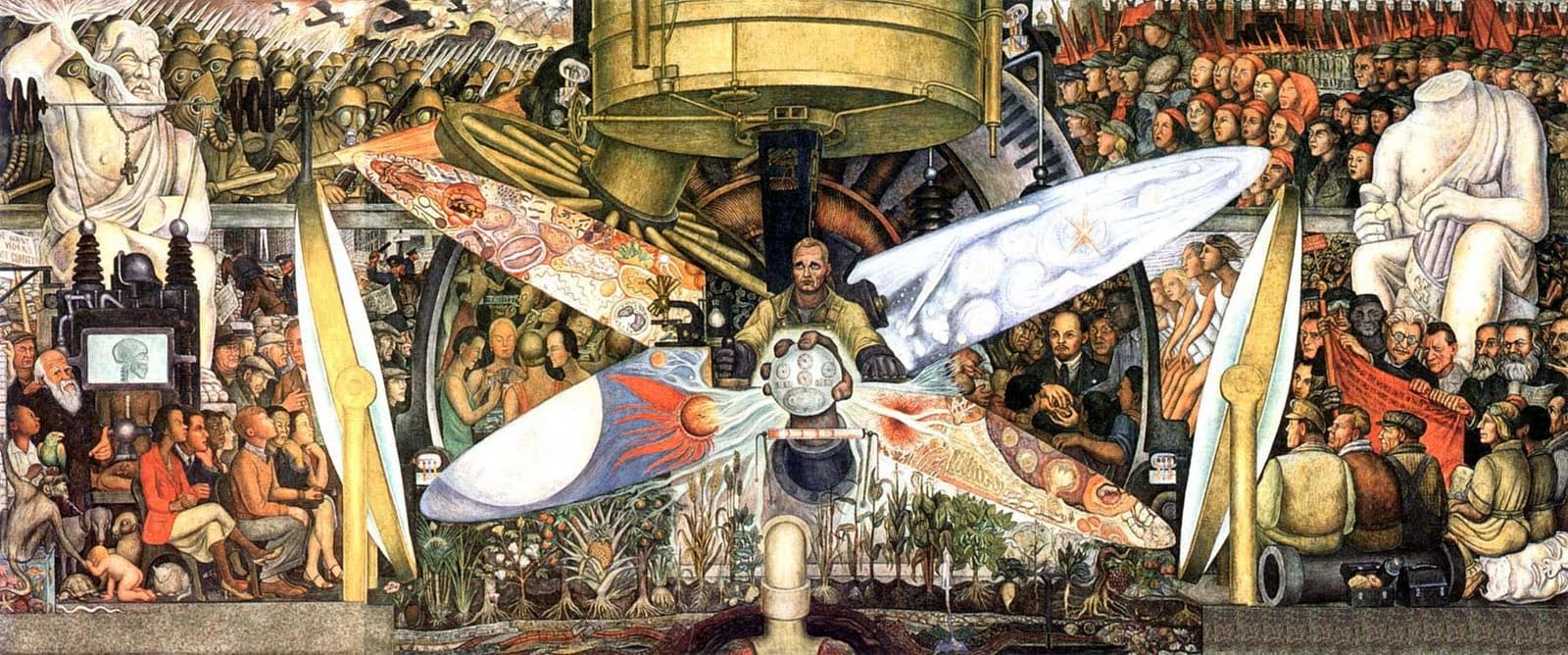
Rivera's most public collision with his own politics happened not in Mexico but in New York. In 1932, John D. Rockefeller Jr. commissioned him to paint a lobby mural for the new Rockefeller Center, and Rivera accepted, despite being a fired party member with an openly Marxist worldview. The result, "Man at the Crossroads," was a mural for the lobby of their newly built Rockefeller Center in New York City that Rivera used to argue for a socialist future over capitalist industry.
The trouble was a portrait of Vladimir Lenin that Rivera added to the composition. Building management objected almost immediately, and when Rivera refused to remove it, building managers were infuriated with the addition of Soviet Communist Vladimir Lenin and the negative publicity it was attracting, so they ordered Rivera to remove the offending image. Rivera would not budge. The standoff ended badly:
when Rivera refused, Rockefeller had the mural covered up with canvas, and eventually he ordered its destruction. Rivera was paid in full for his work, but the incident caused a major scandal in the art world, and it led to a public debate about the role of art and politics. The episode effectively ended Rivera's major American commissions, but it also cemented his reputation as an artist who would not compromise his politics for patronage, even wealthy capitalist patronage.
Sheltering Trotsky, Then Breaking With Him
An Unlikely Houseguest at Casa Azul
By the mid 1930s Rivera had moved from Stalinist orthodoxy toward open sympathy for Leon Trotsky, the exiled Bolshevik whom Stalin's regime wanted dead. When Norway expelled Trotsky in 1936 under Soviet pressure, Rivera used his political connections to help.
It was Rivera who convinced Mexican President Lázaro Cárdenas to offer Trotsky political asylum in Mexico, and the arrangement worked: Trotsky and his wife Natalia Sedova arrived by ship and were given refuge.
Trotsky's stay was long and intimate.
Having become friends with its leader, Leon Trotsky, Diego persuaded Mexican President Cárdenas to grant the Marxist leader political asylum, and Trotsky and his wife Natalia Sedova came to live with Frida and Diego at their home. During his two-year stay at Casa Azul, Trotsky, Diego and the visiting surrealist André Breton wrote the manifesto "For an Independent Revolutionary Art", a document arguing that revolutionary politics required total artistic freedom, a direct rebuke to Stalinist doctrine on state-controlled art.
The Affair, the Argument, and the Split
The household arrangement did not last.
Trotsky also, dangerously, had a brief affair with Frida that enraged Diego, and the personal betrayal compounded political disagreements that had been building for months. Historians who study the triangle note that as Diego became increasingly disillusioned with Trotsky's political stances, Frida and Trotsky were known to have a short-lived affair, which only sharpened tensions already present in the household.
By 1939 the friendship had curdled into open rupture. A contemporary account of the falling-out records that the two men came to a parting of the ways: Leon Trotsky announced that he was quitting the Rivera house, and Diego Rivera promptly announced that he was quitting the Trotsky movement. Rivera, who had risked his political standing to bring Trotsky to Mexico, walked away from Trotskyism almost as abruptly as he had embraced it, a pattern that would repeat itself throughout his career.
The Long, Awkward Road Back Into the Party
Having burned bridges with both Stalinists and Trotskyists, Rivera spent the 1940s trying to rejoin the party that expelled him in 1929. The effort was not quick or dignified. According to MoMA's chronology, in the 1940s Rivera submits numerous appeals to rejoin the PCM, but he is not readmitted until September 1954, a quarter century after his expulsion. One account of his Detroit-era troubles notes just how repeatedly he was turned away:
it didn't help Rivera in his almost obsessive attempts to rejoin the Party, and his fourth application to join was rejected. Rivera was finally readmitted in 1954, only three years before his death in 1957, closing a loop that had opened more than thirty years earlier.
Frida Kahlo's own political path ran on a similar but shorter track.
She wrote about Marx, Lenin and Stalin often in her diary, and struggled to make her art more broadly political; one of her last paintings was Marxism Will Give Health to the Sick, painted while Rivera was still locked out of the party he had helped found.
A Legacy Built on Contradiction
Rivera never resolved the contradiction at the heart of his politics: a lifelong Marxist who accepted commissions from American capitalists, a party loyalist expelled for disloyalty, a Trotsky ally who broke with Trotsky, and a painter whose most communist-themed works were destroyed by the very system he criticized. That contradiction is precisely what makes his work compelling to collectors and museums today. His murals and easel paintings are read not as party propaganda but as documents of a real, unresolved ideological struggle, which is part of why institutions and private collectors continue to study and acquire pieces connected to his circle, work you can browse through Latin American art listings drawn from the period.
Rivera's communism was never a settled position. It was a decades-long argument he kept having with the party, with Trotsky, with American patrons, and, in the end, with himself.
Frequently Asked Questions
Did Diego Rivera stay a communist his whole life? Not continuously.
He joined the Mexican Communist Party in 1922 but was expelled as a subversive in 1929, then spent years appealing before he was readmitted in 1954, so his membership was interrupted for roughly twenty-five years.
Why was Rivera expelled from the Communist Party? He was pushed out largely over ideological disputes tied to Stalinism, with sources noting his expulsion came in part because of his criticism of the party's Stalinist direction, and Soviet cultural officials had already condemned him for Trotskyist sympathies during his 1927–1928 trip to the USSR.
What happened to Rivera's Rockefeller Center mural? Rivera included a portrait of Lenin in "Man at the Crossroads," and when he refused to remove it, Rockefeller's team had the mural covered up with canvas and eventually ordered its destruction, even though Rivera was paid in full for the commission.
Was Rivera friends with Leon Trotsky? Yes, for a time. Rivera convinced Mexican President Lázaro Cárdenas to offer Trotsky political asylum and hosted him at Casa Azul, but the friendship ended in 1939 after political disagreements and Trotsky's affair with Frida Kahlo.