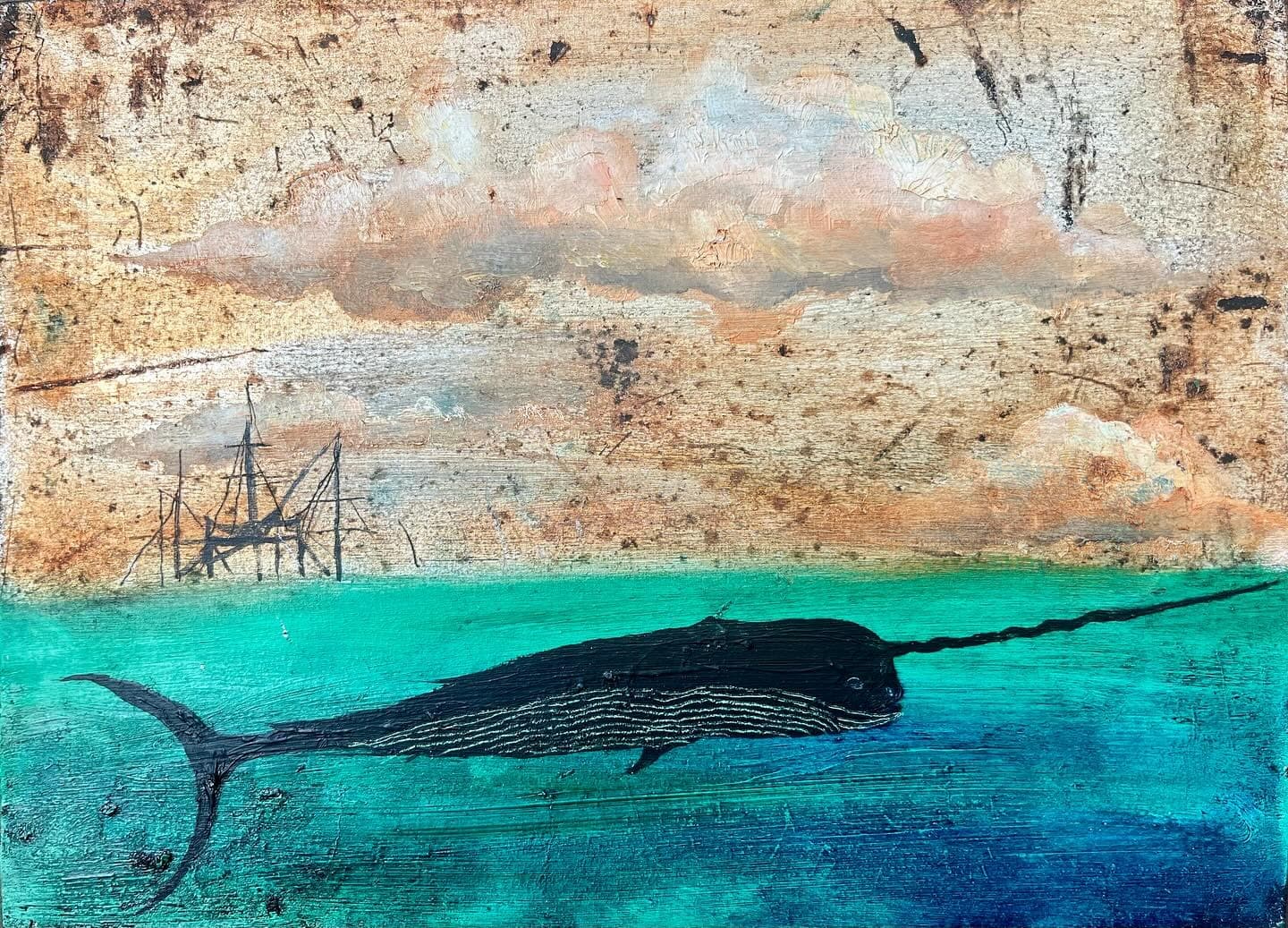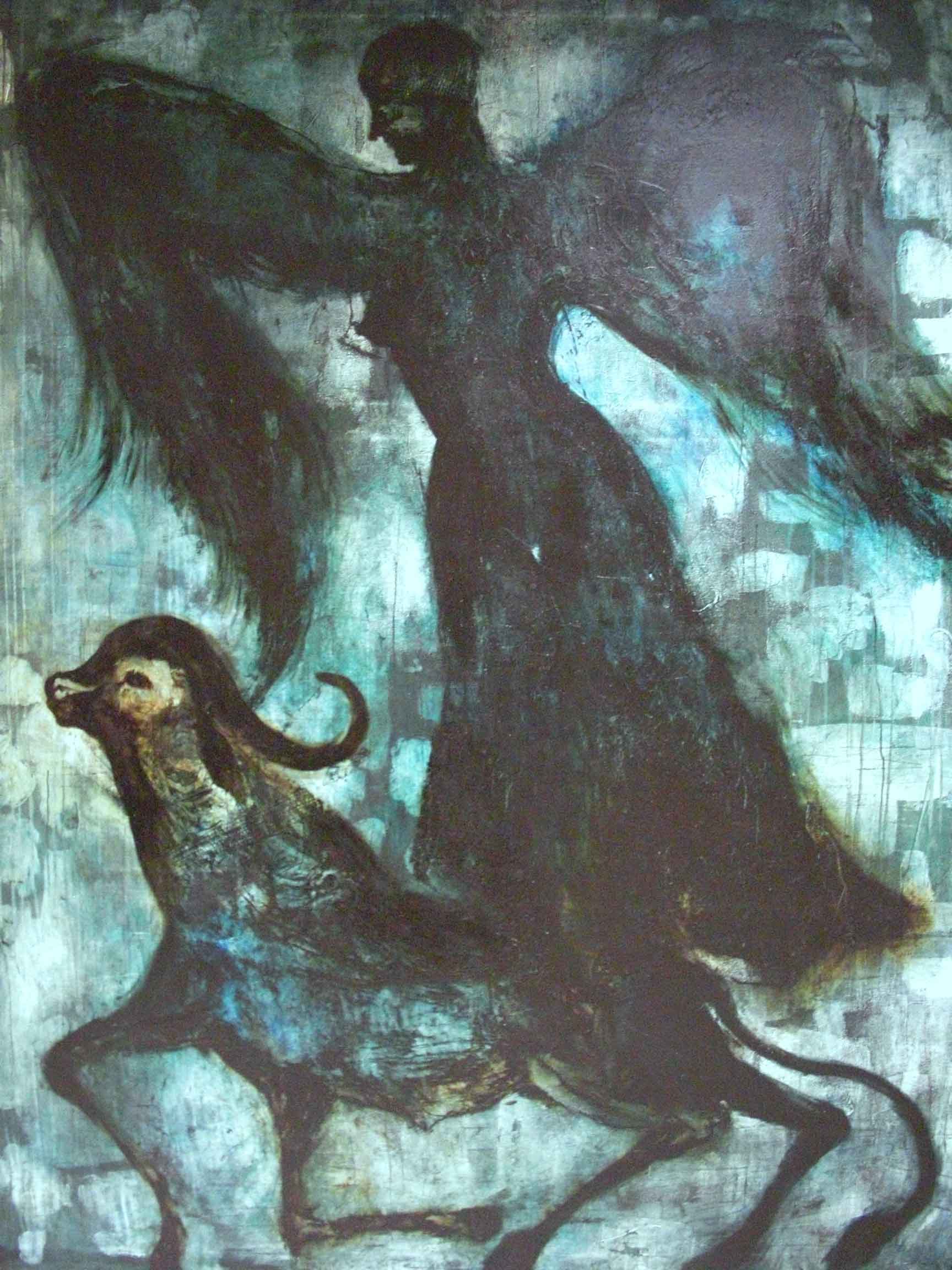
Guillermo Olguín has built a highly personal visual world from travel, memory, mythology and the culture of Oaxaca. Working across painting, drawing, printmaking, altered photography, video and sculpture, Guillermo Olguín combines an international education with experiences rooted in one of Mexico's richest artistic regions.
His paintings can contain animals, masks, vegetation, human figures, objects collected during journeys and references to ritual. Surfaces are layered rather than pristine, often carrying the marks of physical movement and experimentation. For Olguín, travel is not simply a subject depicted after returning home. It is part of the process through which an artwork develops.
Who Is Guillermo Olguín?
Guillermo Olguín Mitchell was born in Mexico City on July 5, 1969. He moved to Oaxaca during childhood, and the region became one of the defining influences on his artistic identity.
According to Mexico's Sistema de Información Cultural, his formal training took him far beyond Oaxaca. He studied photography in Toulouse, France, during 1988 and 1989, followed by painting and computer animation courses in Seattle.
From 1991 to 1993, he studied at the Cornish School of the Arts in Seattle. He later pursued postgraduate studies at the Academy of Art in Budapest, Hungary, in 1995 and 1996.
This combination of Oaxaca, the United States and Europe matters when looking at his work. Olguín does not fit neatly into either a regional or an international category.
His imagery can be unmistakably connected to Mexico while absorbing ideas, techniques and visual experiences gathered far beyond it.
Oaxaca Is Central to Guillermo Olguín's Art
Although born in Mexico City, Olguín's childhood in Oaxaca left a deeper imprint on his visual language.
Oaxaca is home to an unusually dense combination of Indigenous cultures, religious traditions, markets, crafts, festivals and contemporary artistic activity. Catholic practices coexist with traditions whose origins reach much further into the region's history.
Olguín has recalled being fascinated as a child by burials, food, ceremonies and rituals in which Catholic and Indigenous traditions intersected.
Those experiences appear in his art indirectly.
He does not generally document specific ceremonies as an anthropologist might. Instead, masks, animals, plants, bodies and mysterious figures emerge from memory and are recombined into personal mythologies.
This distinction is important. Olguín's Oaxaca is not a picturesque background.
It is a psychological landscape.
Travel Is Both Subject and Working Method
Travel has been a constant throughout Olguín's life.
His education took him to France, the United States and Hungary, while exhibitions and artistic projects have connected him with countries across Europe, Latin America and Asia.
He has described travel as essential to his creative life. New landscapes, photographs, objects and encounters become material for future work.
Sometimes the journey directly enters the object itself.
Olguín has traveled with canvases and works in progress, allowing them to accumulate marks, accidents and physical traces along the way. Rather than protecting a painting until every element is completed under controlled studio conditions, he can treat movement as another stage of its creation.
A canvas therefore becomes more than an image of remembered experience.
It can become an object that has experienced the journey itself.
Guillermo Olguín Builds Paintings Like Collages
Olguín has described his work in terms of collage, even when the final object is predominantly a painting.
This does not necessarily mean cutting and pasting pieces of paper in the traditional sense. The collage occurs through accumulated images, memories, textures and references.
A composition may combine an animal remembered from one place, a photograph found somewhere else, vegetation associated with the tropics, a human form, an ornamental pattern and an object collected during a trip.
The different elements do not need to obey conventional perspective or tell a literal story.
Instead, they operate more like fragments of memory.
That structure helps explain the dreamlike character of many Olguín paintings. Viewers recognize individual elements while remaining uncertain about the precise relationship between them.
The work invites interpretation without providing a single narrative solution.
Animals, Masks and Personal Mythology
Animals occupy a particularly visible place in Olguín's imagery.
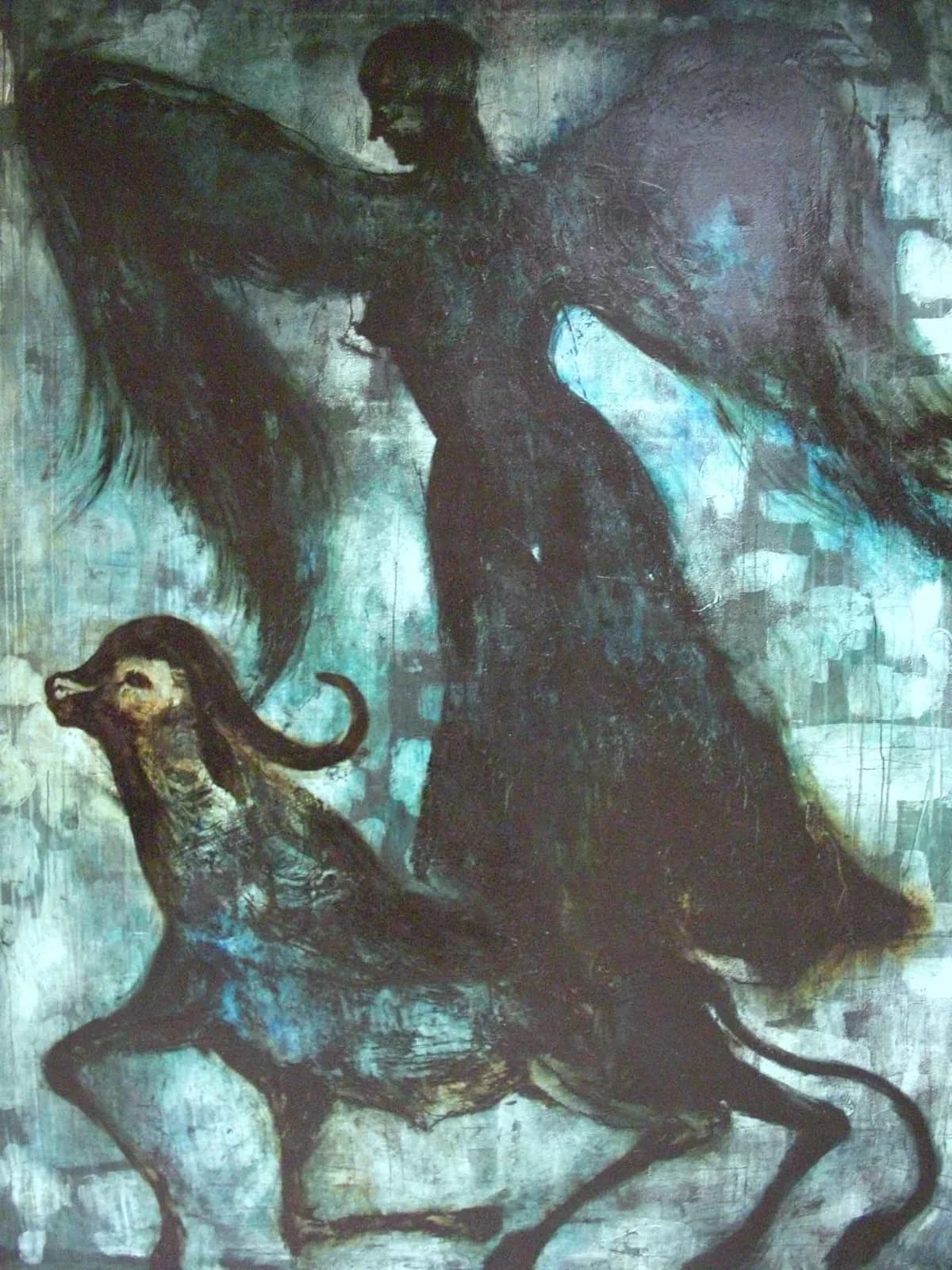
Birds, goats, cattle, rabbits and other creatures appear alongside human figures, masks and organic forms. Sometimes they seem symbolic; elsewhere their presence feels more playful or instinctive.
The artist does not provide a fixed dictionary explaining that one animal always means one specific thing.
This is useful for viewers to remember.
Symbolic art can tempt audiences to decode every element as though solving a puzzle. Olguín's imagery works more fluidly. Meanings can arise from personal memories, mythology, visual attraction and relationships created within an individual composition.
Masks operate in a similar way.
Oaxaca contains numerous traditions involving carved and painted masks used in dances and celebrations. In Olguín's work, mask-like faces can connect contemporary painting with that broader visual environment without simply reproducing traditional objects.
They become characters in an evolving mythology of his own.
Mythology and Pagan Ritual Shape His Visual Language
Descriptions of Olguín's work frequently emphasize mythology and pagan ritual.
These interests help distinguish his imagery from straightforward representations of Oaxacan daily life.
His figures often appear suspended in situations that feel ceremonial or timeless. Animals and people may occupy the same psychological space, while ordinary objects acquire the quality of talismans.
The artist has also described collected objects as amulets.
This collector's instinct is significant. His studio environment has included masks, photographs, books, sculptures and objects acquired during his travels. Such things can eventually migrate into paintings or influence new sculptures.
An object therefore has more than decorative value.
It can become a container for memory.
Printmaking Has Been Important Throughout His Career
Painting may be the medium most immediately associated with Olguín, but printmaking has remained a consistent part of his practice.
His early graphic training included work in Seattle, where he developed experience with printmaking processes and encountered approaches including Japanese sōsaku-hanga. The term refers to the modern Japanese "creative print" movement, which emphasized the artist's direct involvement in designing, carving and printing a work.
Olguín has also experimented with processes that combine photography and printmaking, including chine-collé and lithographic techniques.
This willingness to mix traditional and contemporary processes is characteristic of his career.
His prints include etching and aquatint, lithography, screen printing and other techniques. Rather than treating graphic work as a secondary reproduction of his paintings, Olguín has used printmaking as an independent field for experimentation.
In 2025, the exhibition Guillermo Olguín: 30 años de gráfica at La Cúpula in Mérida reviewed approximately three decades of this side of his practice.
Why Prints Matter to Collectors
Original prints can provide a more accessible entry point into the work of an established artist, but collectors should understand exactly what they are purchasing.
An etching or lithograph is not simply a photographic reproduction of a painting. The artist works through a printing process to create an image intended to exist in an edition.
Collectors should verify:
The printing technique.
Edition number and total edition size.
Artist's signature.
Printer or workshop, when documented.
Dimensions of both image and sheet.
Condition of the paper.
Provenance and previous ownership.
Terms such as artist's proof, often abbreviated A.P. or P.A., should also be documented. These impressions normally exist outside the numbered commercial edition.
Photography Becomes Something to Transform
Olguín's relationship with photography is equally experimental.
Instead of treating a photograph as necessarily finished when the camera captures an image, he has intervened on photographic surfaces and collaborated with photographers.
Paint, drawing and other marks can alter the original image.
This process allows photography and painting to occupy the same object rather than remain separate disciplines.
It also reflects a larger characteristic of Olguín's practice: very little needs to remain in its original state.
A photograph can be painted. A memory can become mythology. A traditional technique can be combined with a contemporary one. A collected object can enter a sculpture.
Transformation is more important than purity.
From Small Traveling Works to Monumental Paintings
Olguín works comfortably at radically different scales.
Small drawings and paintings can accompany him while traveling, functioning almost like visual notebooks. At the opposite extreme, large canvases allow gestures and figures to become physically immersive.
The change in scale affects the experience of the work.
In a small piece, the viewer may approach closely and examine an intimate cluster of marks. A large Olguín painting can surround the visual field, allowing figures, drips, layers and expanses of color to operate with greater physical force.
That versatility is part of what makes his work difficult to reduce to a signature format.
The recurring identity comes from his imagery and process rather than a standardized size or composition.
An International Education Without Losing a Local Identity
Olguín's career illustrates an important aspect of contemporary Latin American art: internationalism does not require abandoning local experience.
His training in Seattle and Budapest exposed him to different artistic traditions. Travel expanded the geographic range of his references. His work has been exhibited in Mexico, the United States and numerous countries across Latin America, Europe and Asia.
Yet Oaxaca remains visible throughout his practice.
The relationship is not contradictory.
Artists have always moved between places, and some of the most interesting work emerges precisely from the tension between local memory and outside experience.
Olguín's art occupies that space.
He can absorb a technique encountered abroad while returning to an animal, ritual, landscape or memory associated with Oaxaca.
Guillermo Olguín as a Cultural Promoter
Olguín's connection with Oaxaca extends beyond his studio practice.
He has participated actively in the city's cultural life and helped develop spaces where visual art could intersect with music, film, food and social activity.
Among these projects was Café Central, an Oaxaca venue associated with music, film and visual arts for more than a decade.
He also became involved with mezcal culture through Los Amantes and later with Casa Mezcal in New York.
These activities are relevant because they demonstrate a broader understanding of culture.
For Olguín, Oaxaca's artistic identity is not confined to paintings hanging inside galleries. Music, food, mezcal, craft traditions, social gatherings and visual art overlap.
The boundaries between cultural production and everyday life are porous.
Where Has Guillermo Olguín Exhibited?
Olguín began exhibiting professionally during the early 1990s.
Among his documented solo exhibitions are an Open Studio Gallery Walk presentation in Seattle in 1991; La mar y sus pescaditos at Galería Quetzalli in Oaxaca in 1995; Viajes por Egipto at the Mexican Embassy in Budapest in 1996; and Héroes y Dioses at Galería Quetzalli in 2000.
His exhibition Un Mundo Raro was presented at Galería y Bodega Quetzalli in Oaxaca in 2008 and subsequently at the Museo de Arte de Querétaro in 2009.
Over the course of his career, his work has appeared in exhibitions across Mexico, the United States, Cuba, Paraguay, Brazil, Argentina, Italy, the United Kingdom, Germany, Spain, Portugal, France, Finland, Hungary and Japan.
Institutional collections holding his work include the Allen Memorial Art Museum at Oberlin College, which identifies him as a Mexican artist born in 1969. His work has also been associated with public collections in Oaxaca, including the Museo de Arte Contemporáneo de Oaxaca and Instituto de Artes Gráficas de Oaxaca.
What Makes Guillermo Olguín's Art Distinctive?
Several characteristics combine to make Olguín's work recognizable.
First is the tension between Oaxaca and the wider world. His work is rooted in memories of local culture but continually transformed by travel.
Second is his refusal to separate mediums rigidly. Painting, photography, printmaking, drawing and sculpture feed one another.
Third is the role of accumulated experience.
Olguín does not seem interested in producing images stripped of history. His surfaces, objects and symbols often appear to have already lived.
Wear, age, accidental marks and visual imperfections can therefore become productive rather than problematic.
Finally, there is a poetic dimension that resists complete explanation.
A bird, mask, figure or animal may suggest mythology without illustrating a particular myth. The image can feel familiar and strange simultaneously.
That uncertainty is part of its power.
What Collectors Should Know About Guillermo Olguín
Olguín has worked across a broad range of media and price categories, so collectors need to compare like with like.
A unique oil painting, a drawing, an altered photograph and a numbered print are fundamentally different objects.
Before acquiring a work, verify:
Complete medium and support.
Dimensions.
Date of creation.
Whether the work is unique or editioned.
Edition information for prints.
Provenance.
Exhibition history, if claimed.
Gallery invoices, certificates or archival records.
Condition and previous restoration.
For mixed-media pieces, documentation should identify the materials as precisely as possible.
Collectors should also be cautious about relying solely on stylistic resemblance. Olguín has produced a wide range of images during a career spanning more than three decades.
A signature alone does not establish authenticity.
Documented provenance, gallery records and comparison with securely attributed works provide stronger evidence.
Readers can explore Guillermo Olguín on LatinAmericanArt.com, browse additional artists, examine artworks and discover participating galleries.
Guillermo Olguín and Oaxacan Rituals
Olguín represents a model of Mexican contemporary art that is both intensely local and comfortably international.
His work does not treat Oaxaca as an isolated tradition that must be protected from outside influence. Nor does it abandon local culture in pursuit of an interchangeable global contemporary style.
Instead, he allows different worlds to collide.
Oaxacan rituals coexist with European training. Printmaking traditions encounter photography. Childhood memories mix with landscapes discovered while traveling. Collected objects become amulets and then reappear as imagery.
The result is an art based on accumulation rather than simplification.
A Life Transformed Into Visual Memory
Travel may be the most useful metaphor for Guillermo Olguín's entire practice.
A traveler carries some things forward, leaves others behind and inevitably changes the meaning of what is remembered.
Olguín's paintings operate similarly.
Oaxaca remains present, but it is continually reconstructed through distance, experience and time. Animals become symbols. photographs are altered. memories merge with mythology. Objects gathered along the way acquire emotional weight.
After more than three decades of work, his visual language remains identifiable precisely because it has never stopped absorbing new material.
For Olguín, the destination appears to matter less than what can be collected, remembered and transformed along the way.
Frequently Asked Questions About Guillermo Olguín
Where was Guillermo Olguín born?
Guillermo Olguín was born in Mexico City in 1969. He moved to Oaxaca during childhood, and Oaxaca became one of the most important cultural and visual influences on his work.
Where did Guillermo Olguín study art?
He studied photography in Toulouse, painting and computer animation in Seattle, and attended the Cornish School of the Arts in Seattle from 1991 to 1993. He later pursued postgraduate studies at the Academy of Art in Budapest.
What type of art does Guillermo Olguín make?
Olguín works in painting, drawing, printmaking, altered photography, video and sculpture. He is particularly known for expressive, layered compositions that combine mythology, ritual, travel, animals, memory and imagery connected to Oaxaca.
Why does travel matter in Guillermo Olguín's work?
Travel supplies Olguín with images, objects, landscapes and experiences that enter his work. He has also carried artworks with him during journeys, allowing physical movement and accidental marks to become part of their development.
Is Guillermo Olguín an Oaxacan artist?
Olguín was born in Mexico City but grew up in Oaxaca and has maintained a deep connection with its artistic and cultural life. He is widely identified with the contemporary Oaxacan art scene while maintaining an international practice.