Olga Sinclair occupies an unusual position in Latin American art. The Panamanian painter inherited a direct connection to her country's modernist tradition through her father, Alfredo Sinclair, yet developed a visual language defined by her own forceful use of color, bodily forms, gestural brushwork and movement between figuration and abstraction.
What makes Olga Sinclair especially distinctive is that her career extends well beyond the production and exhibition of paintings. She has also made art education a central part of her public life, building an international foundation that has introduced tens of thousands of children to painting. Few established Latin American artists have combined a sustained studio practice with cultural advocacy on this scale.
Olga Sinclair Grew Up Inside Panamanian Modernism
Olga Sinclair was born in Panama City in 1957 into an unusually influential artistic environment. Her father, Alfredo Sinclair Ballesteros, was one of the significant figures in the development of modern painting in Panama and is closely associated with abstraction and expressive experimentation in Panamanian art.
For Olga, painting was therefore not something discovered later in life. The studio was part of childhood.
She began working under her father's guidance and participated in an exhibition with professional painters when she was only 14. That early exposure provided technical experience, but it also created a challenge that has confronted many second-generation artists: how to establish an identity independent from a famous parent.
Sinclair ultimately did so by absorbing the freedom of modernism without simply reproducing her father's approach.
Her development can be understood as a conversation between inheritance and independence. The experimental attitude came partly from her surroundings, but the sensuality, physicality and recurring human presence in her mature work became distinctly her own.
Classical Drawing Sits Beneath Her Expressive Painting
One reason Sinclair's paintings can appear spontaneous is that the underlying technical training is easy to overlook.
In 1976, she moved to Spain and studied at Madrid's Escuela de Artes Aplicadas y Oficios Artísticos. She also received extensive instruction in classical drawing before returning to Panama, where she studied interior design at the Universidad Santa María La Antigua and worked with printmaking.
Those disciplines matter when looking closely at her paintings.
Even when Sinclair pushes a composition toward abstraction, her forms often retain a sense of anatomical structure. Curves may suggest a shoulder, torso, reclining figure or intertwined bodies without becoming conventional portraits.
This ability to move between recognizable anatomy and abstract form distinguishes her from artists whose abstraction begins primarily with geometry or completely nonrepresentational mark-making.
Abstraction Without Completely Abandoning the Figure
Sinclair's career has moved repeatedly between figuration and abstraction rather than following a simple progression from one to the other.
In some works, the body is clearly identifiable. In others, it survives only as a suggestion: a contour, weight, curve or mass of color.
That ambiguity gives viewers something to discover rather than simply recognize.
A painting may initially appear abstract and then gradually reveal a torso or human relationship. Conversely, a recognizable figure can dissolve into paint, texture and movement when viewed more closely.
The result is an art that frequently operates in the territory between seeing a body and feeling its presence.
Color Is One of Olga Sinclair's Most Recognizable Tools
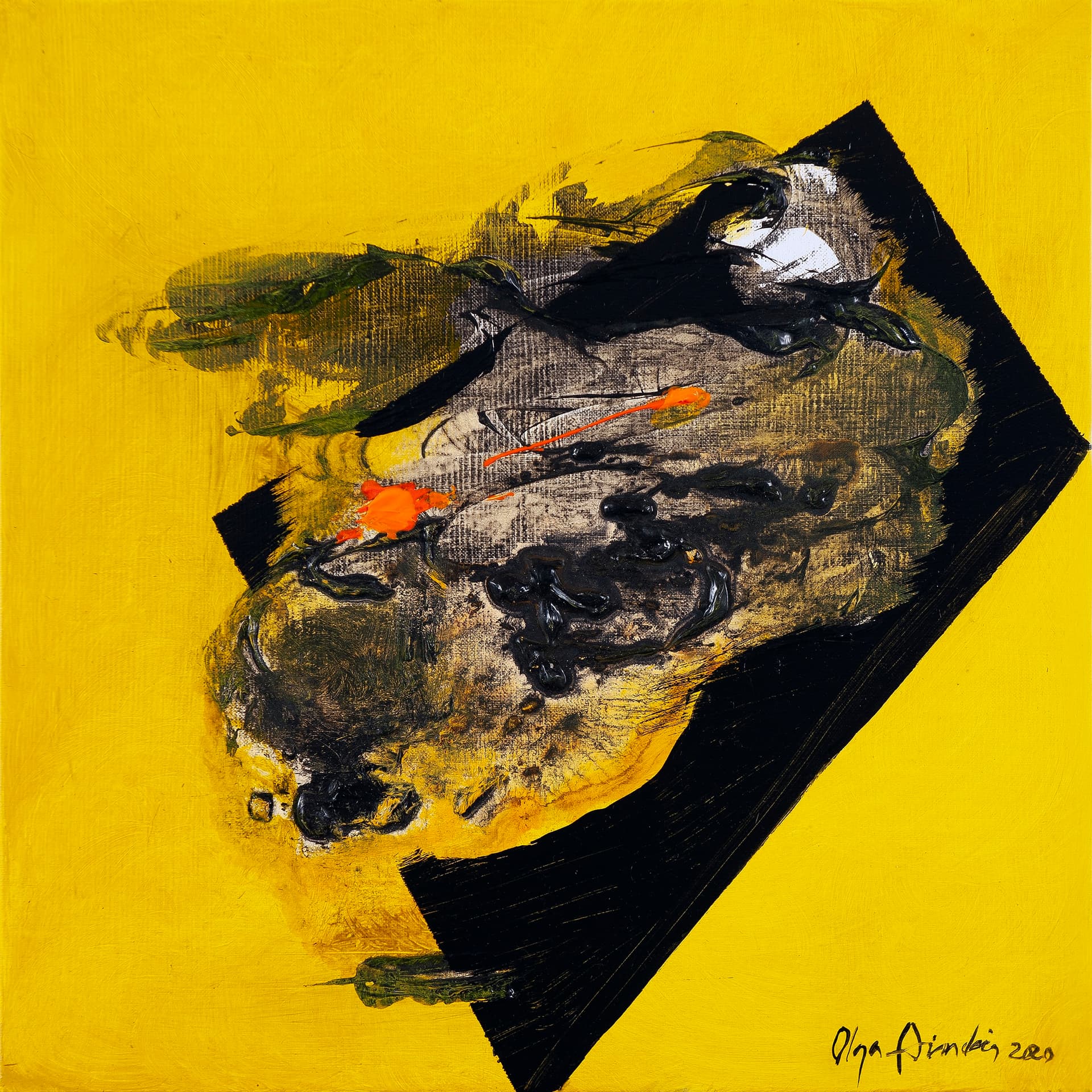
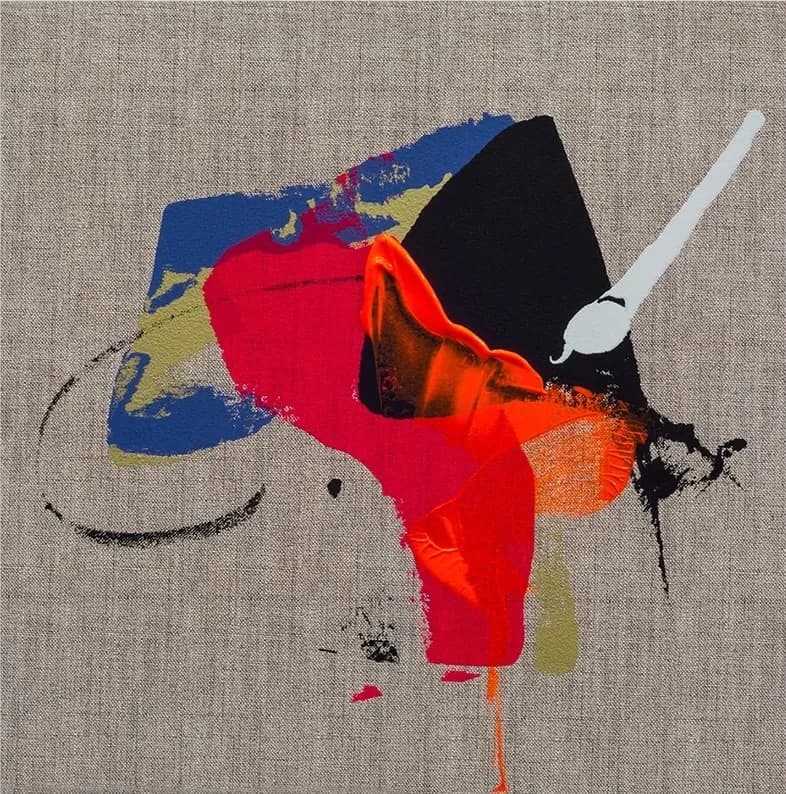
Sinclair's paintings often depend on saturated, assertive color.
Reds, yellows, oranges, deep blues and greens can occupy large areas of the canvas. Rather than functioning merely as decoration, color establishes rhythm, emotional temperature and spatial relationships.
Her official biography describes a palette shaped partly by the tropical environment. That connection is useful, but Sinclair's paintings should not be reduced to a simple idea of "tropical color." Her combinations can be confrontational as well as joyful, and dark passages often sit beside intense areas of pigment.
The physical handling of paint is equally important.
Broad gestures, sweeping curves and energetic transitions give many compositions a sense of motion. Instead of hiding the painter's hand, Sinclair frequently allows the movement that produced an image to remain visible.
That physical quality helps explain why reproductions can only partially communicate her work. Scale, surface and the relationship between gestures become considerably more apparent in person.
[Image placeholder: Detail of an Olga Sinclair painting showing energetic brushwork, saturated color and partially abstracted human forms — use the Image button to upload it here]
The Female Body Appears Without Becoming a Conventional Portrait
The human body, particularly the female form, has been an important element throughout Sinclair's work.
Her treatment differs from traditional portraiture. Individual identity is often secondary to gesture, volume, sensuality and the relationship between forms.
Figures can appear monumental even when they occupy an intimate composition. Bodies stretch, recline, overlap or become simplified into large curved shapes.
The Fundación Museo Bolivariano in Colombia, whose collection includes Sinclair's 1988 painting La espera de Fermina, has described the importance of abstraction and feminine essence within her work. That painting is executed in oil on canvas and illustrates an earlier stage in Sinclair's continuing dialogue between representation and abstraction.
This recurring interest in the body creates continuity across a career that otherwise includes substantial stylistic experimentation.
Her International Career Has Remained Closely Connected to Panama
Sinclair has exhibited extensively outside her home country, with work shown across Europe, the Americas and Asia.
Her exhibition history includes presentations at Casa de América in Madrid, Palazzo Medici Riccardi in Florence, the Jordan National Gallery of Fine Arts in Amman and cultural institutions in Spain and Portugal. A major retrospective was also organized in Panama City in 2018.
Her work is held in collections that include the Museo de Arte Contemporáneo de Panamá, Museo del Canal Interoceánico, Fundación Juan March in Madrid, the Organization of American States' art collection in Washington and the United Nations complex in Geneva, according to the artist's official exhibition records.
These international connections have not weakened her identification with Panama. Sinclair has consistently maintained a strong public cultural presence in the country and was named a Cultural Ambassador of Panama in 2014.
In 2024, Panama's Ministry of Environment also named her a climate ambassador, extending her public role into environmental advocacy.
For readers interested in discovering more art from the region, LatinAmericanArt.com's artists, artworks and galleries sections provide broader context for contemporary and modern Latin American art.
The Olga Sinclair Foundation Makes Her Career Especially Unusual
Sinclair's most distinctive contribution may exist outside the conventional gallery system.
She established the Olga Sinclair foundation to introduce children and young people to art and use creative activity as a tool for cultural and personal development.
The foundation organizes large painting workshops as well as educational programs. According to the organization, more than 100,000 children have participated in its activities across multiple countries.
One event became particularly visible internationally.
In January 2014, 5,084 children painted simultaneously in Panama as part of a project marking the centennial of the Panama Canal. The event earned a Guinness World Record.
This work is not simply a side project attached to Sinclair's name. Education has become an important parallel component of her career.
Her underlying idea is straightforward: exposure to art can encourage creativity, tolerance and more constructive ways of interacting with other people.
Whether or not one accepts every broader claim made for arts education, the scale of Sinclair's commitment is notable. Many artists conduct workshops or participate in educational programs. Sinclair built an institution around them.
Why Collectors Respond to Olga Sinclair's Work
For collectors, Sinclair offers several overlapping points of interest.
There is first the visual accessibility of the work. Her paintings can communicate immediately through color and movement without requiring specialized theoretical knowledge.
There is also substantial career documentation. Sinclair has exhibited for decades, participated in international exhibitions and entered institutional collections. A catalogue documenting works from 1995 through 2008 was published in association with Arte al Día in 2009, providing another reference point for researchers and collectors.
Collectors evaluating a Sinclair painting should still apply the same standards used for any established artist.
What Should a Buyer Verify?
Before purchasing a work attributed to Olga Sinclair, a collector should examine:
Provenance, including previous galleries and owners
Exhibition history, if one is claimed
Invoices or certificates supplied by recognized galleries
Dimensions, medium and date
Signature placement and whether it corresponds with documented works
Condition, particularly for large painted surfaces
References in catalogues or archival documentation when available
A signature alone is never sufficient proof of authenticity.
Buyers should also distinguish original paintings from editions or other multiples. Sinclair has worked across different media, and size, technique, date and edition status can substantially affect how an object should be evaluated.
For collectors comparing works currently available through participating dealers, the LatinAmericanArt.com artworks and galleries sections can provide a useful starting point.
Olga Sinclair Cannot Be Reduced to a Single Movement
Trying to classify Sinclair simply as an abstract painter misses much of what makes her interesting.
Her work contains elements of abstraction, expressionism and figuration, but none fully defines it. Classical drawing remains present beneath apparently free gestures. Human forms repeatedly emerge from abstraction. Intense color can dominate a canvas without becoming its only subject.
That resistance to a single category reflects the larger arc of her career.
She belongs to a generation of Latin American artists who inherited the transformations of twentieth-century modernism but did not feel obligated to remain inside one formal doctrine.
In Sinclair's case, experimentation became the constant.
Her Legacy Extends Beyond the Canvas
Olga Sinclair's uniqueness ultimately comes from the combination of several careers within one life.
She is the daughter of an important Panamanian modernist who succeeded in developing an independent identity. She is a classically trained draftsperson who embraces gestural painting. She moves comfortably between bodies and abstraction, and between an intensely Panamanian identity and an international exhibition career.
She has also treated access to art as something worth building an institution around.
That final element changes how Sinclair's career should be evaluated. Her legacy is not limited to paintings hanging in museums, galleries or private collections. It also includes generations of children for whom a Sinclair workshop may have been their first opportunity to stand in front of a canvas and discover what making art feels like.
Frequently Asked Questions About Olga Sinclair
Where is Olga Sinclair from?
Olga Sinclair was born in Panama City, Panama, in 1957. Although she studied and lived abroad at different stages of her life, Panama has remained central to both her artistic identity and cultural work.
Who was Olga Sinclair's father?
Her father was Alfredo Sinclair Ballesteros, an important Panamanian modernist painter associated with abstraction and experimentation. Olga began learning in his studio at an early age but later established a separate artistic language and international career.
Is Olga Sinclair an abstract artist?
Partly. Sinclair has worked in both abstraction and figuration, and some of her strongest paintings occupy a space between the two. Human bodies and anatomical forms frequently remain visible or implied even when a composition appears largely abstract.
Where can Olga Sinclair's work be seen?
Her work is represented in public and institutional collections in Panama and internationally, including collections associated with the Museo de Arte Contemporáneo de Panamá, Fundación Juan March and the Organization of American States. Availability for public viewing depends on whether individual works are currently displayed.
What is the Olga Sinclair Foundation?
The Olga Sinclair Foundation is an arts education organization created by Sinclair to encourage creativity and cultural development among children and young people. Its programs have included workshops in Panama and internationally, including large-scale collaborative painting events.