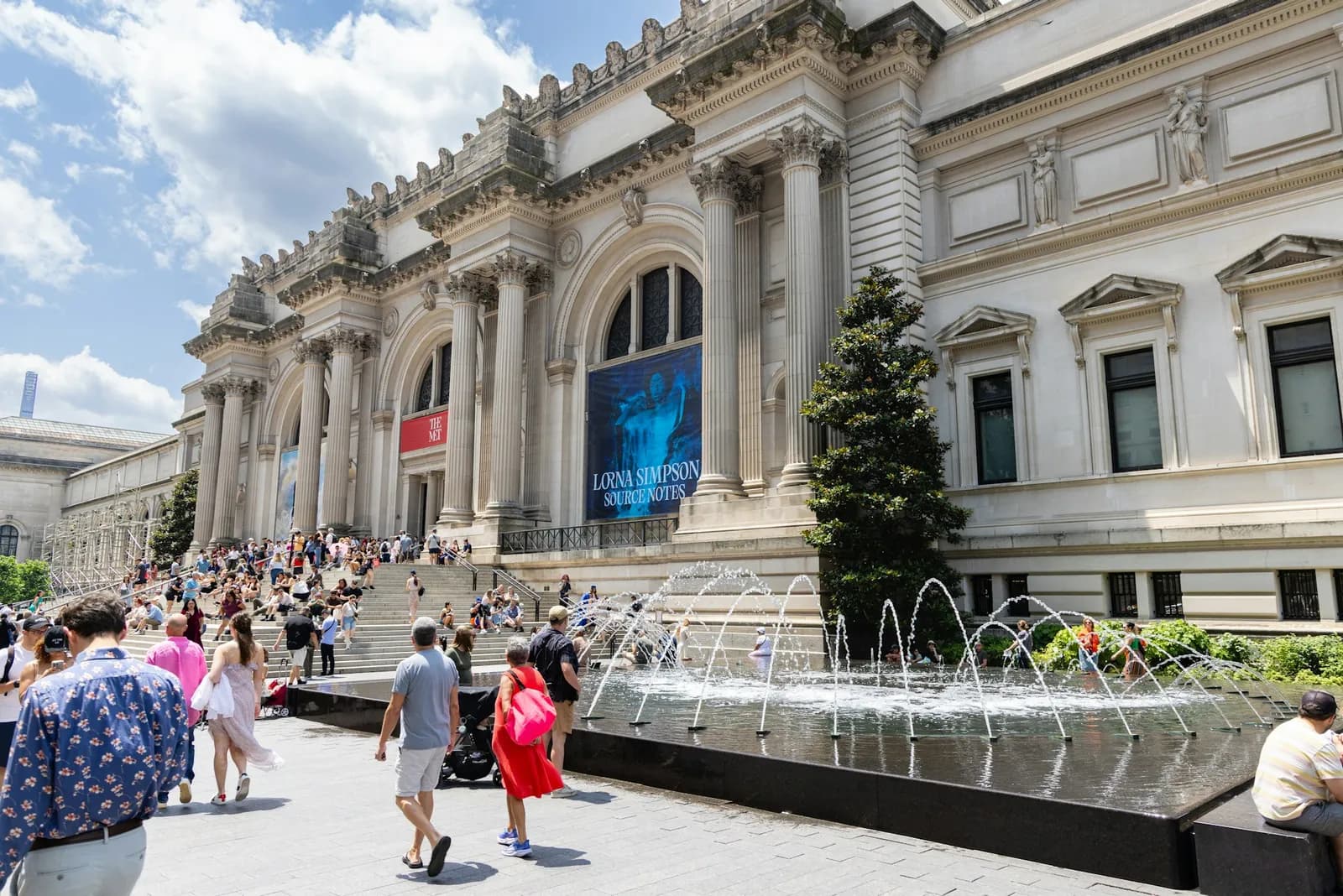
The Metropolitan Museum of Art has officially begun construction on its new wing for modern and contemporary art, a $670 million project that will reshape how the museum presents 20th and 21st century work, including key pieces by Latin American artists. The Metropolitan Museum of Art broke ground on the Oscar L. Tang and H.M. Agnes Hsu-Tang Wing, a long-awaited addition that will house the museum's collection of modern and contemporary art. The ceremony took place on September 15, 2026, and drew museum leadership, elected officials and the architect herself.
Mexican architect Frida Escobedo joined museum leadership and elected officials to celebrate "la primera piedra," or "the first stone," of the forthcoming Tang Wing. For collectors and readers who follow Latin American art specifically, the groundbreaking matters for a concrete reason: the wing will give greater visibility to artists from the region, including the Cuban-born painter and sculptor Carmen Herrera, whose Azul "Tres" (1971) is part of the Met's modern and contemporary holdings.
What the Met's New Wing Actually Includes
The numbers behind the project are substantial. The five-storey, 126,000-square-foot space is designed by the Mexican architect Frida Escobedo, the first woman to create a wing for the museum in its 156-year history. That distinction was repeated throughout the ceremony, underscoring how rare it still is for a woman architect to lead a major museum expansion of this scale.
Of that total footprint, the new wing will increase available exhibition space by almost 50 percent to 6,460 square meters (69,500 square feet), giving curators far more room to rotate works that have long been kept in storage for lack of gallery space. The project has taken years to reach this stage. In 2022, the Met announced Mexico City–based architect Frida Escobedo as the project designer, and in 2025 revealed the long-awaited designs for the new wing, scheduled to open in 2030.
Funding the wing required one of the largest capital campaigns in the museum's history. The Met has so far raised $670 million, which will cover construction costs along with a "significant portion" of the wing's operating costs, according to a statement from the museum. The revamped space is named in honor of Oscar Tang and Agnes Hsu-Tang, who pledged the largest capital gift in the Met's history.
Who Is Frida Escobedo
Escobedo has built a career on projects that blend architecture with public space and cultural memory, making her an apt choice for a museum wing meant to hold work from across the Americas. Born in 1979 in Mexico City, Escobedo studied architecture at the Universidad Iberoamericana in Mexico City before completing a master's degree in public art at Harvard's Graduate School of Design.
Her international profile grew substantially after London's Serpentine Gallery selected her for one of its most visible commissions. She was, in 2018, the youngest architect to design the annual Serpentine Pavilion, and she is also a co-designer for the renovation of the Pompidou Centre. That combination of a landmark temporary pavilion and a permanent overhaul of one of Europe's most important modern art museums gave the Met confidence that she could handle a project of comparable ambition in New York.
Why Carmen Herrera's Work Belongs in This Story
Carmen Herrera's presence in the Met's modern and contemporary collection is a reminder that Latin American artists have shaped the history of postwar abstraction in the United States, even when recognition came late. Carmen Herrera (May 31, 1915 to February 12, 2022) was a Cuban-born American abstract, minimalist visual artist and painter. She was born in Havana and lived in New York City from the mid-1950s. She spent decades working in near obscurity in a Manhattan studio before the art world caught up with her hard-edge geometric paintings.
Her 1971 sculpture Azul "Tres" marked a turning point in her practice, the moment she moved off the wall and into three dimensions. She hired a carpenter who assisted her in creating Azul "Tres" (1971), her first monochromatic, free-standing structure. The piece grew out of a broader body of work Herrera had been developing on paper for years. In the late 1960s and early 1970s, Herrera began to work with a carpenter to translate her drawings into wooden sculptural Estructuras, and that process resulted in the important smaller Azul "Tres" (1971).
Azul "Tres" was not an isolated experiment. In 1971, Herrera fabricated four Estructuras in wood, three wall-based works and one free-standing piece. Decades later, several of these early sculptures were reimagined at monumental scale for outdoor installation, a project realized through venues like the Public Art Fund, which based one of its large-scale pieces directly on the smaller original. Herrera's work fits a body of practice defined by extreme discipline. She is known for her hard-edge paintings, prints, and sculptures, often built around a self-imposed rule of working in only two or three colors at a time.
The Met's decision to feature Azul "Tres" within its modern and contemporary holdings places Herrera alongside American and European minimalists whose work she predates in some respects, even though she received far less institutional attention during the same decades. Readers who want to see how her sculptural language developed can compare the 1971 original to later fabrications through the Whitney Museum's Carmen Herrera exhibition page, which traces her career across paintings, prints and sculpture.
What the Expansion Means for Latin American Art
A larger, better-organized wing changes what a museum can show and how often. For a collection that includes artists from across Latin America, from Brazilian concretists to Mexican modernists to Cuban minimalists like Herrera, more square footage typically means fewer works cycling in and out of storage and more room for the kind of thematic, cross-regional installations that place Latin American artists in direct conversation with their North American and European peers rather than in a separate room labeled by geography.
The Met has signaled that the new galleries will organize modern and contemporary art thematically rather than strictly by nationality or chronology, following a curatorial approach that other major institutions have adopted in recent years. For collectors and gallerists who track institutional placement as a signal of market and scholarly interest, a Met gallery rotation is one of the clearest indicators that an artist's reputation has solidified. You can browse current artworks and artists with ties to major museum collections on LatinAmericanArt.com, and follow institutional news through our editorial section as the Tang Wing project moves forward.
A Timeline of the Tang Wing Project
Year | Milestone |
|---|---|
2022 | Met announces Frida Escobedo as design architect |
2025 | Museum unveils final designs for the wing |
September 2026 | Official groundbreaking ceremony |
2030 | Planned opening |
Frequently Asked Questions
Why is the new Met wing named the Tang Wing? The space is named in honor of Oscar Tang and Agnes Hsu-Tang, who pledged the largest capital gift in the Met's history toward the project's construction and endowment.
How much bigger will the museum's exhibition space become? The new wing will increase available exhibition space by almost 50 percent to 6,460 square meters (69,500 square feet), within a total 126,000-square-foot structure.
Who is Frida Escobedo, and why was she chosen to design the wing? Escobedo is a Mexican architect known internationally for the 2018 Serpentine Pavilion and her role on the Pompidou Centre renovation, and she is the first woman to create a wing for the Met in its 156-year history.
Will Carmen Herrera's work be featured in the new wing? Herrera's sculpture Azul "Tres" (1971) is already part of the Met's modern and contemporary holdings, and the expanded galleries are expected to give works like hers more consistent exhibition space once the wing opens in 2030.
When will the new wing open to the public? The Met revealed the designs for the new wing in 2025, with an opening scheduled for 2030.