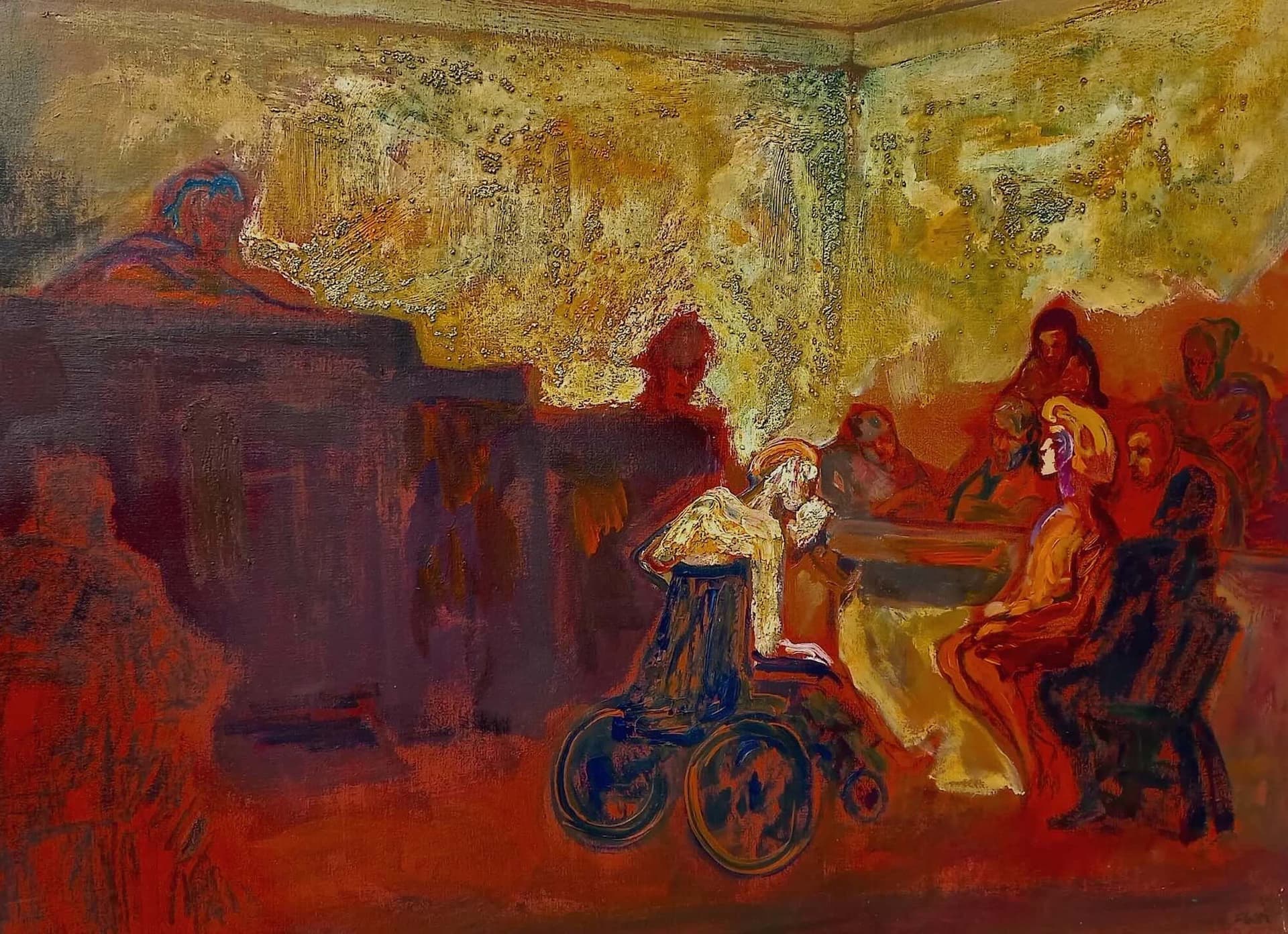
Luis Filcer was a Mexican Expressionist painter who spent seven decades turning ordinary human pressure, poverty, crowds, war, exhaustion, into paint. Born in Zhytomyr, Ukraine, in 1927 and brought to Mexico as an infant, he built a career on subjects that most of the Mexican art market avoided: miners, market vendors, subway passengers, gamblers and mourners. Expressionism, the movement he claimed without hesitation, means distorting color, line and proportion to convey emotion rather than describe appearance, and Filcer used it as a moral instrument.
He is not a household name outside Mexico, which is exactly why he rewards attention. His paintings appear regularly at auction in Mexico City and the Netherlands, often at prices far below those of his better known contemporaries. You can see available works on his artist page.
Who Was Luis Filcer?
Filcer was born to a Jewish family in Zhytomyr, then part of the newly formed Soviet Union. When he was about six months old the family fled anti-Jewish persecution following the Russian Revolution and made the long crossing to Mexico City, where the boy registered as Liev Filtzer became Luis Filcer.
The family settled in La Lagunilla, the dense market district north of the historic center. His father spoke almost no Spanish and sold clothing in the street before joining other immigrants in a sweater factory. That childhood, immigrant, cash-poor, surrounded by street commerce, is visible in almost everything Filcer later painted.
A Note on His Dates
Sources disagree on the specifics. English-language reference materials give December 4, 1927 and a death on July 19, 2018 in San Miguel de Allende, while a memorial column by the writer Araceli Ardón, a personal friend, gives December 24, 1927 as his birth date and July 26, 2018 as the day he died. Auction houses simply list 1927-2018.
Training: San Carlos, Bardasano and the Taller de Gráfica Popular
Filcer entered the Academia de San Carlos in Mexico City at sixteen, in 1943, attending classes in the morning and working in the afternoon. His father considered painting a waste of time until his son actually sold a picture.
Academic training bored him. He spent three years in the workshop of the exiled Spanish painter José Bardasano, concentrating on drawing, and in 1949 he worked at the Taller de Gráfica Popular, the collective printmaking workshop founded in 1937 that produced politically committed linocuts and lithographs. That combination, rigorous draftsmanship plus a print shop devoted to social protest, set the terms of his entire career.
The Van Gogh Decision
After reading a biography of Vincent van Gogh, Filcer decided to do what Van Gogh had done in the Borinage: live among working people and paint them. He traveled to Guanajuato and spent time with miners. Van Gogh remained a lifelong reference point, and late in life he was still building whole exhibitions around him, including a 2017 show titled "El eco eterno de Van Gogh" at a gallery in San José del Cabo.
Europe, and the Museums That Actually Taught Him
Scholarships took him to Paris and Rome. His account of the Rome academy is blunt: he lasted about a month, quarrelled with a teacher who wanted him to paint bohemians instead of laborers, and walked out. The real education came from the museums of Rome and Florence, where he studied the old masters directly, and from Goya, whose grotesque late work he returned to for the rest of his life.
Twenty Years in the Netherlands
Filcer lived and worked in the Netherlands for more than two decades, much of that time in De Rijp, a village in North Holland, before returning to Mexico. This period explains two things collectors notice.
First, a substantial body of his work circulates in Dutch and Belgian sale rooms rather than Mexican ones, which is why small Filcer drawings surface at regional Dutch auctions. Second, the northern European debt in his palette and his heavy, worked surfaces: Rembrandt's darkness sits behind his Mexican subjects. In 1998 he was named a Knight of the City of Maastricht.
What Luis Filcer Painted
His themes were consistent to the point of obsession, and knowing them is the fastest way to recognize an unsigned photograph of a Filcer.
Crowds in transit. Subway cars and platforms in Mexico City, New York and Madrid, passengers pressed together, faces smeared by motion and fluorescent light.
Labor and poverty. Miners, market women, campesinas, street sellers, carriers bent under loads.
Political violence. The Mexican Revolution of 1910 and the 1968 Tlatelolco massacre, treated as continuing conditions rather than closed history.
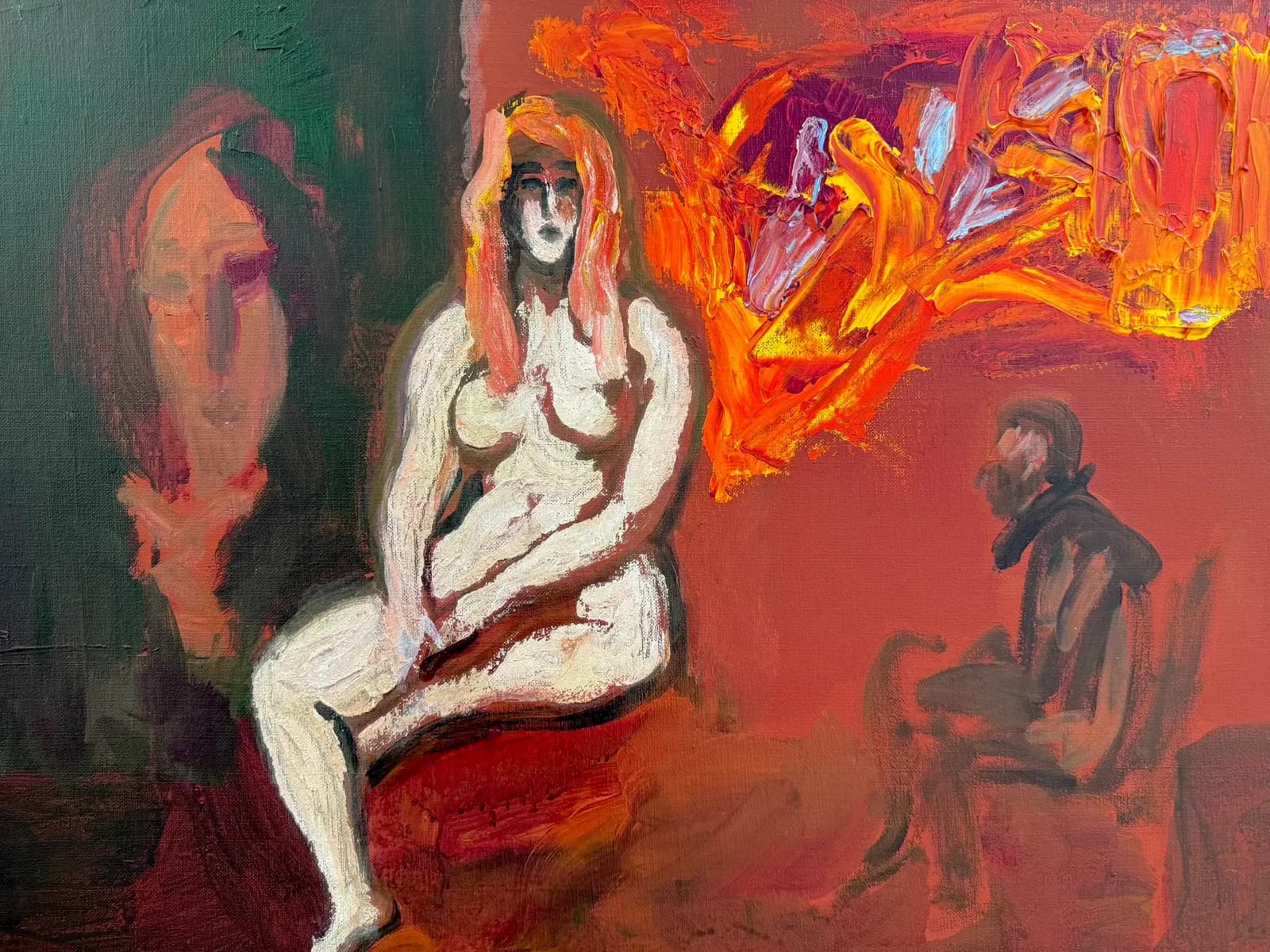
Spectacle and vice. Las Vegas casinos, actors, flamenco dancers, the painter and his model.
Homages. Long series devoted to Van Gogh, to Goya and to museum visitors looking at paintings.
He put it directly in interviews: he painted what he lived plus his fantasies and his demons, and whatever moved him he painted.
Technique
Filcer settled early on chiaroscuro, the dramatic opposition of light and dark inherited from Baroque painting, and never really left it. Figures emerge from brown-black grounds into bursts of cadmium red, ochre and acid green.
He worked in oil and, increasingly from the 1980s onward, acrylic on canvas, at scales up to roughly 150 by 130 centimeters. Alongside the paintings there is a large graphic output: mixed media on paper, ink and watercolor drawings, etchings and signed serigraph editions. The drawings are fast and confident, and they are where his San Carlos training shows most clearly.
Recognition, Exhibitions and Institutional Standing
Filcer was a member of the Salón de la Plástica Mexicana, the artist-run institution founded in 1949 and now part of Mexico's Instituto Nacional de Bellas Artes y Literatura. Membership is a meaningful marker of standing in the Mexican art establishment. His name appears alongside Leonora Carrington, Rufino Tamayo, Juan Soriano and Gilberto Aceves Navarro in a Secretaría de Cultura announcement about an exhibition drawn from the Instituto Politécnico Nacional's art collection.
Gallery and press biographies credit him with more than 300 exhibitions, representation of Mexico at biennials in Santiago de Chile, Tokyo and Brighton, and inclusion in a Grand Palais group show of contemporary expressionists in Paris. Those claims come from dealer material rather than museum catalogs, so verify individual line items before repeating them in a catalog entry of your own.
One tribute is well documented: in May 2014 the Museo de Bellas Artes de Toluca mounted a sixty-year retrospective homage with roughly 120 works, organized around his recurring series, including the museum observer, Van Gogh, the models, the homage to Goya and religious subjects.
Collecting Luis Filcer: Market and Prices
The center of the Filcer market is Morton Subastas in Mexico City, which has handled his work for decades and continues to offer it in modern and contemporary sales. A typical lot is a signed mixed-media sheet, sometimes carrying a personal dedication.
Recent published estimates, in Mexican pesos, give a useful map. These are pre-sale estimates, not hammer prices, and buyers pay a premium plus applicable tax on top.
Format | Example size | Estimate range (MXN) | Rough USD equivalent |
|---|---|---|---|
Signed serigraph, numbered edition | 26.5 x 20 cm | 2,500 to 3,500 | 130 to 190 |
Mixed media on paper | 28 x 38.5 cm | 8,000 to 15,000 | 430 to 800 |
Larger mixed media on paper | 48.5 x 38.5 cm | 12,000 to 20,000 | 650 to 1,100 |
Oil on canvas | 79 x 100 cm | 40,000 to 50,000 | 2,200 to 2,700 |
Dollar figures are approximate and move with the exchange rate. Comparable sales are tracked on Invaluable's Filcer price guide, which also records small drawings sold through Dutch houses such as Veilinghuis Van Spengen.
What to Check Before You Buy
Signature and dedication. Filcer often signed twice and frequently inscribed gifts. A dedication is not a defect, but it narrows the resale pool.
Medium accuracy. Sale listings sometimes say "mixed media" for what is essentially charcoal and watercolor. Ask for a condition report and raking-light images.
Support condition. Acrylic and ink on paper from the 1980s and 1990s is prone to light staining and tape residue at the corners.
Provenance geography. Dutch provenance is normal for this artist, not a red flag.
Subject strength. His crowd scenes and mining subjects consistently outperform his generic studio nudes. Buy the theme he is known for.
If you are comparing him with other mid-century figures, browse current listings and participating galleries before committing.
Frequently Asked Questions
Was Luis Filcer Mexican or Ukrainian? Both, in sequence. He was born in Zhytomyr, Ukraine, in 1927 and arrived in Mexico before his first birthday, so his entire formation as an artist was Mexican. He is consistently classified as a Mexican painter, and his Jewish immigrant background is central to how critics read his work.
What makes his work Expressionist rather than Social Realist? Social Realism describes conditions; Expressionism distorts them. Filcer twisted anatomy, exaggerated color and dissolved backgrounds to make the viewer feel pressure rather than observe it. Some Mexican critics call him post-Expressionist for that reason.
Is his work in public collections? His work is held in public and private collections in Mexico, including institutional holdings such as the Instituto Politécnico Nacional collection shown through the Salón de la Plástica Mexicana. Museum catalog records for individual pieces are patchy online, so ask a seller for documentation rather than assuming museum provenance.
Where can I see or buy a Filcer today? Morton Subastas in Mexico City is the most reliable source, with occasional appearances at Dutch and Belgian auctions and through Mexican galleries. Estate material still enters the market through his family and former dealers. Watch upcoming events for sales and exhibitions.
Is he a good entry point for a Latin American art collection? For a collector who wants serious mid-century Mexican painting without six-figure prices, yes. A strong drawing can be had for a few hundred dollars and a substantial canvas for a few thousand, and his reputation rests on a documented seventy-year career rather than on speculation.