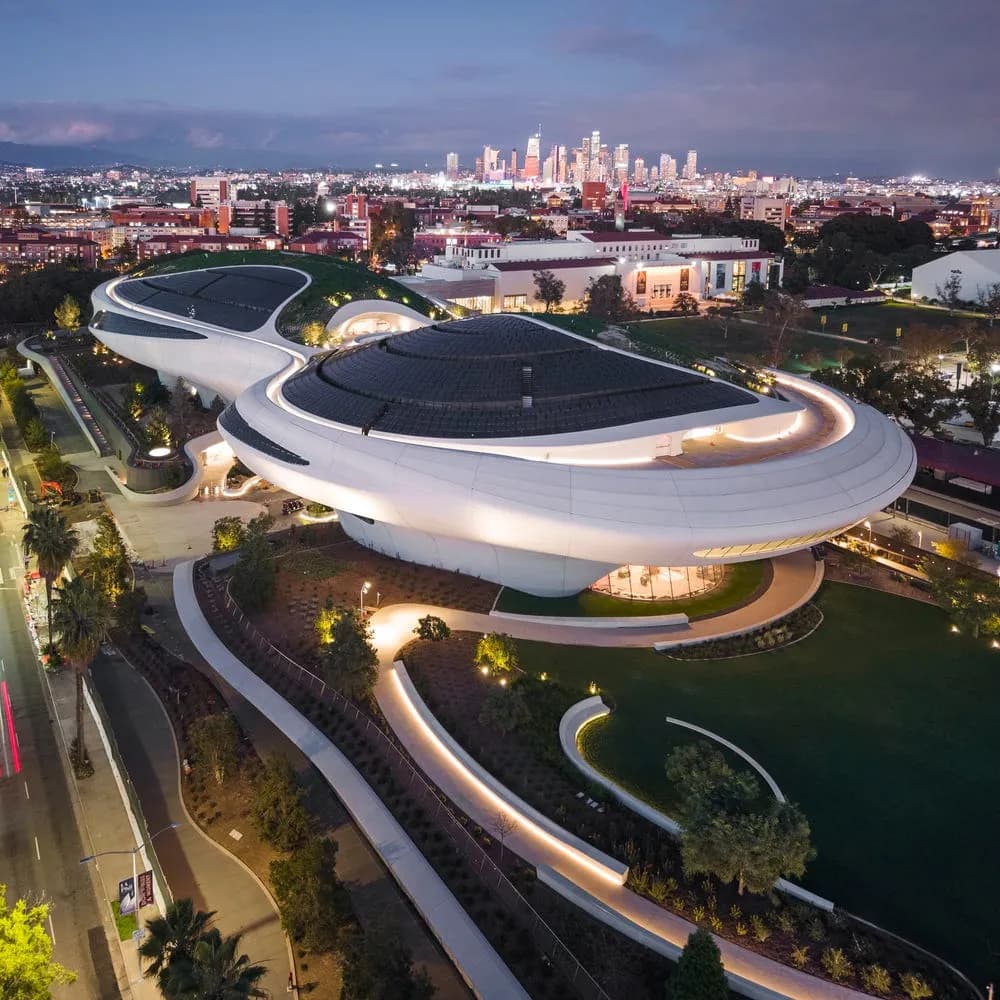
The Lucas Museum of Narrative Art will open its doors on September 22, 2026, in Los Angeles, and Latin American artists occupy a genuine, if still modest, place inside its 40,000-work collection. Founded by filmmaker George Lucas and his wife, financier Mellody Hobson, the museum has spent 16 years and roughly $1 billion moving from concept to completed building. For collectors and readers who follow Latin American art, the more interesting question than the opening date is what the museum actually holds, and how it positions Mexican, Mexican American and Chicano storytellers within a collection built mostly around American illustration and comics.
When and Where the Museum Opens
After years of delays and two earlier proposed sites in Chicago and San Francisco, the museum finally has a firm date. According to the museum's own announcement, the Lucas Museum of Narrative Art will open its doors to the public on Tuesday, September 22, 2026, as a first-of-its-kind institution dedicated to showcasing the universal tradition of storytelling through images. The building sits in Exposition Park, the same South Los Angeles cultural corridor that already holds the California Science Center and the Natural History Museum.
The scale is considerable. The 11-acre campus is located in Exposition Park in Los Angeles and features a 300,000-square-foot building with 35 galleries total. The building was designed by Ma Yansong, founder of MAD Architects, and Mia Lehrer of Studio-MLA, whose firm describes the project as a gift to the State of California and City of Los Angeles, adding new public green space to a part of the city that has long lacked it.
What "Narrative Art" Means Here
Lucas has spent five decades assembling illustration, comics, film material and paintings under one broad idea: images that tell stories. The museum's permanent collection includes more than 40,000 works of narrative art, and the opening presentation will show only a slice of it. The inaugural exhibitions trace the history of narrative art through around 1,300 works from the museum's collection, arranged by theme, such as family, community and adventure, rather than by strict chronology or medium. Readers who want the full context of that founding collection can browse the museum's official artist list or compare it against the broader roster on LatinAmericanArt.com's artists directory.
Where Latin American Artists Fit
Given that the founding collection leans heavily on American illustrators such as Norman Rockwell, N.C. Wyeth and Maxfield Parrish, Latin American representation is not the museum's dominant note. But it is not absent either, and the pieces that are present carry real weight.
Frida Kahlo's Self-Portrait
The best-known Latin American work in the collection is a Frida Kahlo self-portrait. Reporting on the acquisition described the collection includes also Frida Kahlo's 1940 well-known painting "Self-Portrait Dedicated to Dr. Eloesser," purchased by the Lucas holdings, a canvas Kahlo painted for the San Francisco physician who treated her for much of her life. The museum's own site frames the work as central to its storytelling mission: it moves from Frida Kahlo's self-portrait to Norman Rockwell's scenes of everyday life to Charles White's portraits of dignity, treating all three as equally weighted forms of narrative art. Coverage of the museum's opening reinforces the same pairing, noting that Lucas and Hobson are betting those visitors will stay for artworks by Frida Kahlo and Norman Rockwell, photographs by Gordon Parks, comics by Frank Miller and other artists once they arrive for the Star Wars material. Britannica's overview of the museum's holdings likewise lists Kahlo among the small group of painters on display are paintings by Norman Rockwell, Charles White, Frida Kahlo, Jacob Lawrence, and Utagawa Kuniyoshi, a useful sign of how prominently she figures in the museum's own self-description.
Judith F. Baca and the Muralist Tradition
The museum's official artist page also credits the Chicana muralist Judith F. Baca, best known for the mile-long Great Wall of Los Angeles and decades of community mural work across Southern California. The site notes that the collection also embraces modern and contemporary artists, including Frida Kahlo, Jacob Lawrence, Charles White, Robert Colescott, and muralists such as Judith F. Baca. Her inclusion matters for Latin American art readers specifically, because it ties the museum's mission to the Chicano mural movement that grew out of Los Angeles itself, rather than treating Latin American narrative art as an import from elsewhere.
Rafael Navarro and Latino Comics
The inaugural exhibition checklist also draws on Latino voices from the comics side of the collection. Coverage of the opening lineup credits Rafael Navarro, art for Sonámbulo: Mexican Stand-Off, 2006, placing the Mexican American cartoonist's noir wrestler-detective series alongside better-known names like Frank Frazetta and Jack Kirby in the museum's genre-fiction galleries. It is a small credit, but a telling one: it shows the museum reaching into independent Latino comics rather than relying solely on canonical fine-art names.
A Curator Who Shaped the Vision, Then Departed
For years, the person most responsible for pushing Latinx and Chicano art into the museum's planning was Pilar Tompkins Rivas, who joined as chief curator in 2020. Before that appointment, the appointment of Pilar Tompkins Rivas as chief curator and deputy director of curatorial and collections at the Lucas Museum of Narrative Art followed years running the Vincent Price Art Museum, and she had served as a co-curator of the CSRC-organized exhibitions L.A. Xicano and other landmark Chicano art shows in Los Angeles. Her background made her an unusually well-suited advocate for Latin American and Latinx representation inside a collection built by a private collector with different tastes.
That advocacy will not continue in the same role, however. Just weeks after the September 2026 date was announced, the Lucas Museum of Narrative Art's chief curator, Pilar Tompkins Rivas, is leaving the museum, with the museum's interim leadership stating there were no immediate plans to fill the position. For readers tracking how Latin American art gets represented at major new institutions, her departure is worth watching: curatorial turnover at this stage can shift which stories a museum chooses to tell first, and which get pushed later into rotating exhibitions rather than the founding installation.
What This Means for Collectors and Visitors
For collectors and gallery owners, the Lucas Museum's opening is less about acquisition activity, since Lucas built this collection privately over 50 years, and more about validation. A Kahlo self-portrait and a Judith Baca mural credit sitting inside a $1 billion museum built by one of Hollywood's most famous collectors sends a signal to the wider market that Latin American narrative painting and muralism belong in the same conversation as American illustration and comics.
Visitors planning a first trip should expect the Latin American material to be modest in volume but meaningful in placement, appearing in thematic galleries alongside Rockwell, Wyeth and comic-book artists rather than in a separate wing. Readers who want to track how the collection grows after opening, including any future acquisitions or loan exhibitions with Latin American or Latinx focus, can follow LatinAmericanArt.com's editorial coverage and check the site's running list of upcoming events tied to major museum openings.
FAQ
When exactly does the Lucas Museum of Narrative Art open? The museum opens to the public on Tuesday, September 22, 2026, at its Exposition Park campus in Los Angeles.
Does the Lucas Museum have a dedicated Latin American art wing? No. Latin American works, including Frida Kahlo's self-portrait and muralist Judith F. Baca's material, are integrated into the museum's thematic galleries rather than grouped into a separate regional wing.
Who curated the Latin American and Latinx portions of the collection? Pilar Tompkins Rivas, previously director of the Vincent Price Art Museum and a veteran of UCLA's Chicano Studies Research Center, served as chief curator from 2020 until she departed in December 2025, shortly after the opening date was announced.
How big is the museum's overall collection? The founding collection includes more than 40,000 works spanning illustration, comics, painting, photography and film material, with roughly 1,300 objects on view in the inaugural exhibitions.
Is the Frida Kahlo painting a major work? Yes. The museum holds Kahlo's 1940 "Self-Portrait Dedicated to Dr. Eloesser," a painting she made for the San Francisco physician who treated her for years, making it one of the collection's more art-historically significant acquisitions.