Ask a collector in New York or a curator in Berlin to name a Brazilian art city, and they will say São Paulo or Rio de Janeiro before they say anything else. Brasília, the country's capital since 1960, rarely makes the list, even though it holds federal ministries, embassies from nearly every country on earth, and a university that offers one of Brazil's only undergraduate degrees dedicated entirely to art history and criticism. The gap between what Brasília has and how it is perceived is the real story here, and it says as much about how the Brazilian art market works as it does about the city itself.
Why São Paulo and Rio Still Set the Agenda
Brazil's art infrastructure did not spread out evenly as the country grew. It concentrated in two cities, and it stayed there. São Paulo concentrates the bulk of the country's commercial and institutional infrastructure, including MASP, Pinacoteca do Estado, MAM-SP, Instituto Tomie Ohtake, and the Fundação Bienal de São Paulo, which has organized the Bienal de São Paulo since 1951, the second-oldest recurring biennial after Venice. Rio anchors a parallel ecosystem built around MAM Rio, the Museu de Arte do Rio (MAR), and Instituto Moreira Salles, with smaller but historically important spaces shaping its identity.
That concentration explains the writer's frustration behind this piece: an artist from Bahia, Pará or the Federal District can build a serious body of work at home, but a São Paulo gallery or a Rio museum credit is still what tends to open international doors. Auction houses, art fairs and international press follow the same script, because that is where the collectors, the biennial infrastructure and the trade press already live.
Brasília is not entirely absent from that wider map. Other cities, including Porto Alegre, home to the Bienal do Mercosul, Salvador, Belo Horizonte, Recife, and Brasília, contribute to a scene that, while centralized in the southeast, is not exclusively confined to it. The honest answer to the writer's question, then, is: not yet, but the raw material is there.
What Brasília Actually Has
Visitors who expect a cultural desert are usually surprised. The city's museums are young by European (and Brazilian) standards, almost all built after the capital's 1960 inauguration, but they are serious spaces with real collections and free public access.
Museu Nacional da República
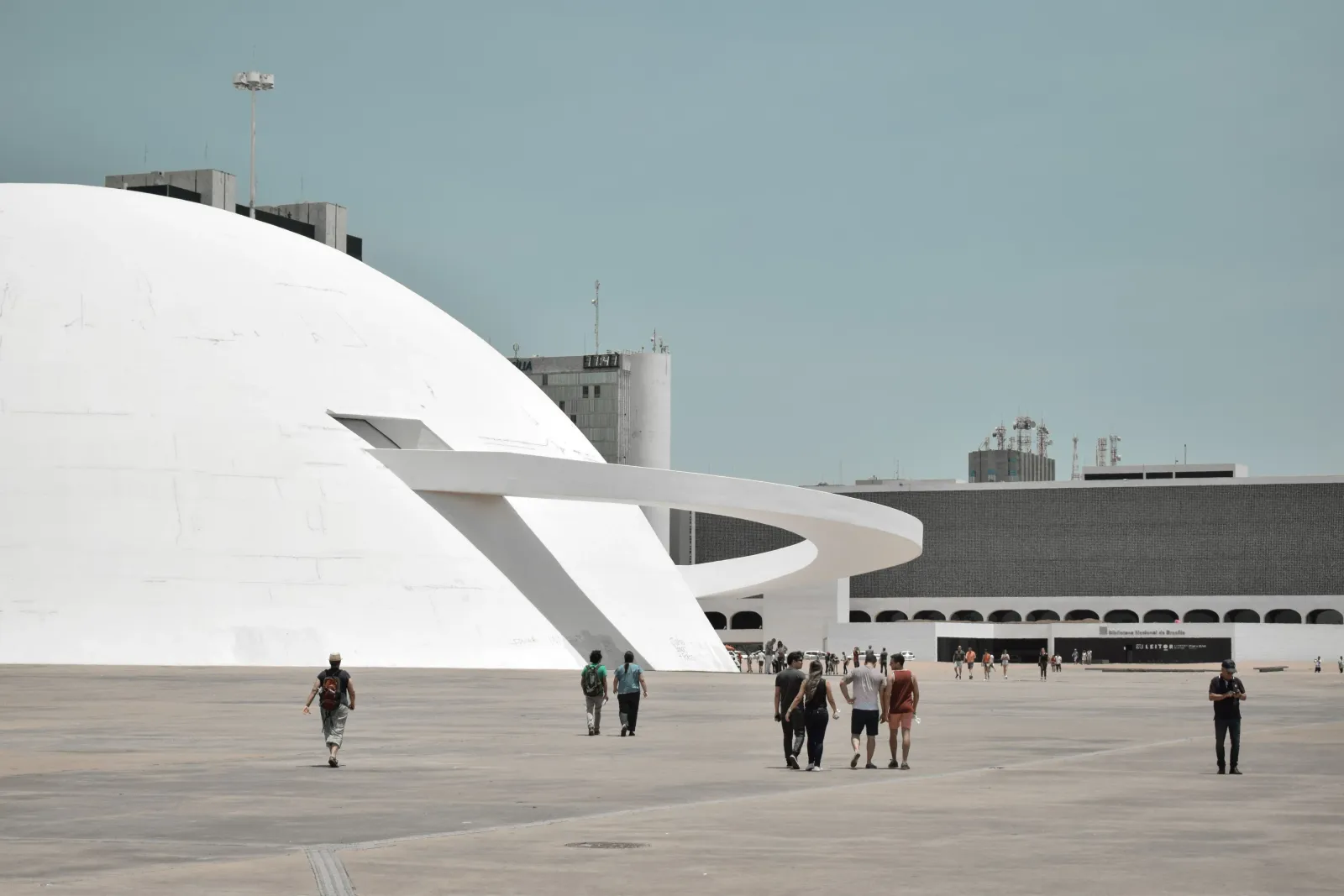
Designed by Oscar Niemeyer as one of his final projects for the capital, this domed museum sits at the western end of the Monumental Axis as part of the Cultural Complex of the Republic. The National Museum of the Republic, called Museu Nacional Honestino Guimarães in Portuguese, consists of a 14,500 square meter exhibit area, two 780-seat auditoriums, and a laboratory. The space is covered with a dome with ramps leading to the entrance, and the building is mainly used to display temporary art exhibits. It opened in December 2006 and runs on funding from the Distrito Federal government rather than a national ministry, which shapes how ambitious its programming can be from year to year.
Centro Cultural Banco do Brasil (CCBB Brasília)
The Banco do Brasil Brasília Cultural Center was inaugurated on October 12, 2000, and its building, an architectural work by Oscar Niemeyer, aims to bring together in one place all possible forms of art and creativity. It is the venue most likely to host a major touring show, such as a recent survey drawn from the Museu de Arte Moderna do Rio de Janeiro collection, which brought roughly a century of Brazilian modern and contemporary art to Brasília audiences for free.
Museu de Arte de Brasília (MAB)
Established in the mid-1980s by the state, the Brasília Museum of Art came into being to preserve and display works of contemporary Brazilian art. Its holdings include pieces by major names from the country's modernist canon, alongside a rotating contemporary program, and like the other major venues in the city, admission is free.
None of this rivals the scale of MASP or MAM Rio, but it is not nothing. The problem is less about supply and more about visibility: these institutions rarely feature in the international art press, and their social media presence is modest compared with what São Paulo galleries or Rio museums post daily.
A Rare Academic Anchor
The strongest argument for taking Brasília seriously as a future art capital is not a museum at all. It is a degree program. The Universidade de Brasília offers a bachelor's degree in Theory, Criticism and History of Art, one of only a handful of programs of its kind in the country. According to the university, the course was created to address a shortage of specialists in this field in Brazil, particularly in the Federal District and the wider Center-West region, and it was built to match the founding ambitions of the university's Central Institute of Arts from the early 1960s: to create a Brazilian art program of international standard.
That matters for a city trying to build cultural weight, because it produces exactly the professionals a growing scene needs: curators, museum researchers and cultural managers who can staff public institutions, write catalog essays, and eventually run galleries of their own. São Paulo and Rio have decades of accumulated infrastructure. Brasília, by contrast, is training the people who might build that infrastructure over the next generation, a slower but arguably more durable strategy.
The City Itself Is the First Artwork
Any conversation about art in Brasília has to reckon with the fact that the city's urban plan and architecture are themselves internationally recognized works of art. Brasília is laid out along a monumental east-west axis, crossed by a north-south axis curved to follow the topography, making it a definitive example of twentieth century modernist urbanism. It was created as the Brazilian capital in the central western part of the country between 1956 and 1960, as part of President Juscelino Kubitschek's national modernization project, bringing together ideas of grand administrative centers and public spaces with new ideas of urban living. UNESCO added Brasília to the World Heritage List in 1987, recognizing Lúcio Costa's urban plan and Oscar Niemeyer's architecture as a single, coherent work.
That legacy is a double-edged sword for the city's contemporary art scene. It draws design pilgrims and architecture students year-round, which is a form of cultural tourism most cities would envy. But it also freezes the popular image of Brasília as a finished, historical monument, something to photograph rather than a place where new art is being made right now.
Access, Money, and Who Gets Invited
The editorial brief behind this article raises a fair and uncomfortable point: even as Brasília produces more exhibitions and events, participation still tends to run through people with existing access, contacts and financial cushioning. This is not unique to Brasília. It is a structural feature of the world art market as a whole, where unpaid internships, self-funded production costs and a small circle of established collectors shape who gets to show and who does not. What makes it feel sharper in Brasília is scale: in a smaller scene with fewer commercial galleries and less press coverage, a handful of well-connected organizers can end up setting the agenda for the entire city, simply because there are fewer alternative venues competing for attention.
Building a wider base means more than adding exhibitions to the calendar. It means public funding that reaches independent and emerging artists directly, university programs (like the one at UnB) that feed graduates into paid curatorial and administrative jobs rather than volunteer labor, and commercial galleries willing to represent artists without an existing São Paulo or Rio credential. Brasília has some of these pieces. It does not yet have all of them working together at scale.
Signs of Momentum
There have been concrete, if modest, signals that the national art market is willing to look toward Brasília. In 2014, SP-Arte, Latin America's largest commercial art fair, took its model outside São Paulo for the first time. SP-Arte held an edition of the fair in Brasília that year, hosting 35 national galleries at the Iguatemi Brasília shopping center, the first edition of SP-Arte held outside São Paulo. Galleries from Bahia, Minas Gerais, Paraná, Rio de Janeiro and São Paulo participated. It was a limited, one-off experiment rather than a permanent fixture, but it proved that the country's biggest fair organizers saw enough of a market in the capital to try.
Meanwhile, Brazil's presence on the global stage continues to run through its two dominant cities. Rosana Paulino and Adriana Varejão have been selected to take over the Brazilian Pavilion at the 2026 Venice Biennale, with Diane Lima serving as curator. Both artists are based in São Paulo and Rio de Janeiro respectively, and the exhibition itself, titled "Comigo ninguém pode," a popular Brazilian saying that translates loosely to "nobody can handle me," and which also doubles as the Portuguese name for the Dieffenbachia plant, has been widely covered internationally. The show marks several historical firsts for the pavilion, including Brazil's first time hosting a Black curator and a Black artist, and one of the first times showing two artists in a united exhibition that extends into the surrounding gardens. It is a genuinely important moment for Brazilian art, and it is also a reminder that the country's most visible cultural exports still originate almost entirely from the same two cities.
What It Would Take
Realistically, Brasília is unlikely to overtake São Paulo or Rio as Brazil's commercial art center in the near term; the collector base, gallery density and auction infrastructure are simply too concentrated elsewhere. But "art capital" does not have to mean market dominance. Belo Horizonte and Porto Alegre have carved out national relevance through specific strengths, the Museu de Arte da Pampulha's Niemeyer building in one case, the Bienal do Mercosul in the other, without competing head-to-head with São Paulo's market. Brasília's path likely looks similar: lean into what already sets it apart.
That means treating the UnB art history program as a pipeline rather than an afterthought, giving its graduates paid roles in the city's museums and galleries. It means CCBB Brasília, the Museu Nacional and MAB coordinating public programming so exhibitions build cumulative visibility instead of competing for the same small audience. And it means using the city's UNESCO status not just as a tourism asset but as a hook to bring visiting curators, critics and collectors into direct contact with the artists actually working in Brasília today, on our artists and galleries pages, in event listings, and in the kind of on-the-ground reporting that editorial coverage like this is meant to provide.
FAQ
Does Brasília have any major art museums? Yes. The Museu Nacional da República, the Centro Cultural Banco do Brasil (CCBB Brasília) and the Museu de Arte de Brasília (MAB) are the three main venues, all offering free admission and a mix of historical and contemporary Brazilian art.
Why isn't Brasília as well known for art as São Paulo or Rio de Janeiro? Brazil's commercial art infrastructure, including its largest galleries, auction activity and the Bienal de São Paulo, concentrated historically in São Paulo and Rio, and that concentration has been self-reinforcing for decades.
Is there a university program for art history in Brasília? Yes. The Universidade de Brasília offers a bachelor's degree in Theory, Criticism and History of Art, created specifically to address a shortage of specialists in the Federal District and the Center-West region.
Is Brasília's architecture itself considered art? Yes. UNESCO designated Brasília a World Heritage Site in 1987, recognizing Lúcio Costa's urban plan and Oscar Niemeyer's buildings as a unified modernist masterwork, which is part of why the city draws design and architecture visitors year-round.
Has a major art fair ever taken place in Brasília? SP-Arte, Brazil's largest commercial art fair, held a one-time edition in Brasília in 2014 with 35 national galleries, though it has not repeated the experiment since.