Miguel Covarrubias
Mexico, b. 1904, d. 1957
Miguel Covarrubias was a Mexican artist, illustrator, writer, and cultural historian born in Mexico City in 1904. He became one of the most versatile and internationally recognized figures in twentieth century Mexican art, known for his work in caricature, painting, theater design, anthropology, and editorial illustration. His career bridged fine art and popular culture, combining sharp observation with a deep curiosity about people, movement, and cultural expression.
Covarrubias showed artistic talent at an early age and began his career as a caricaturist in Mexico City. His ability to capture personality with economy and wit quickly set him apart. In the early 1920s, he traveled to New York, where his career expanded dramatically.
There, he became known for his illustrations and caricatures in major publications, especially Vanity Fair and The New Yorker. His drawings of dancers, musicians, and social figures gained wide attention for their elegance, rhythm, and insight. Rather than exaggeration alone, his caricatures often conveyed the essence of his subjects with remarkable clarity.
During his time in New York, Covarrubias became closely connected to the Harlem Renaissance, a cultural movement that celebrated African American art, music, and literature. He developed friendships with leading figures in the movement and created a series of drawings that documented and interpreted the energy of Harlem life. His work from this period reflects both admiration and careful observation, capturing the dynamism of jazz, dance, and urban culture. This experience also deepened his interest in the relationship between art and cultural identity.
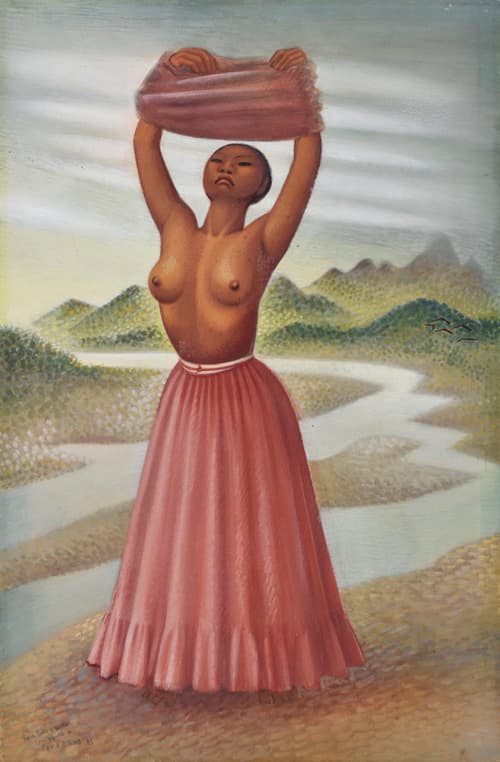
Although he achieved success in the United States, Covarrubias maintained strong ties to Mexico. He returned periodically and eventually settled there again, continuing to work across multiple disciplines. His paintings often reflect a fascination with movement and form, particularly in relation to dance and the human body. He was also interested in geography and culture, creating works that explore the diversity of human expression across regions.
Covarrubias was not limited to visual art. He became an important cultural thinker and writer, publishing books that combined illustration with research and analysis. His works on Bali and on the Pacific region demonstrate his interest in anthropology and cultural systems. These projects reveal a broader intellectual ambition, moving beyond representation to interpretation. He approached cultures with a desire to understand patterns of behavior, belief, and artistic expression, translating these insights into both text and image.
Another significant aspect of his career was his involvement in theater and dance. He designed sets and costumes, bringing his sense of rhythm and composition into three dimensional space. This work reflects his ongoing interest in performance and movement, themes that are also present in his drawings and paintings.
Covarrubias also contributed to museum work and cultural institutions in Mexico. He played a role in shaping exhibitions and promoting the understanding of pre Hispanic and Indigenous cultures. His approach combined respect for tradition with a modern perspective, helping to position Mexican culture within a broader global context.
Throughout his career, Miguel Covarrubias moved fluidly between different fields, refusing to be confined to a single role. This versatility is one of his defining qualities. He brought the same level of attention and curiosity to caricature, painting, writing, and design, creating a body of work that is both diverse and coherent.
Miguel Covarrubias died in 1957. Today, he is remembered as a pioneering figure who expanded the boundaries of Mexican art and cultural expression. His legacy lies in his ability to connect visual art with broader cultural inquiry, offering a nuanced and engaging view of the world through multiple forms of creativity.
Represented By
Artworks by Miguel Covarrubias