Manuel Pailós
Spain, b. 1918, d. 2004
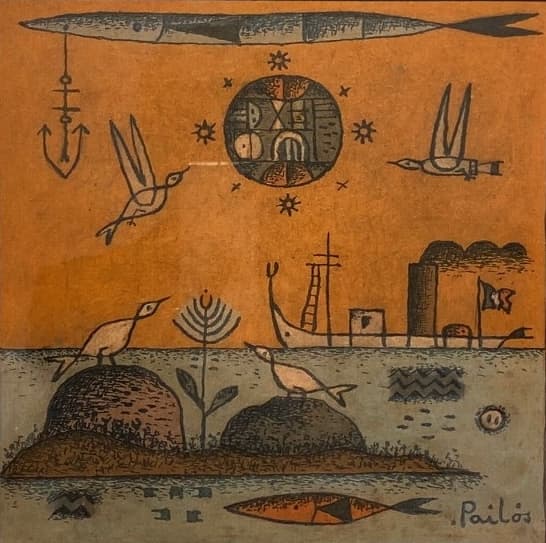
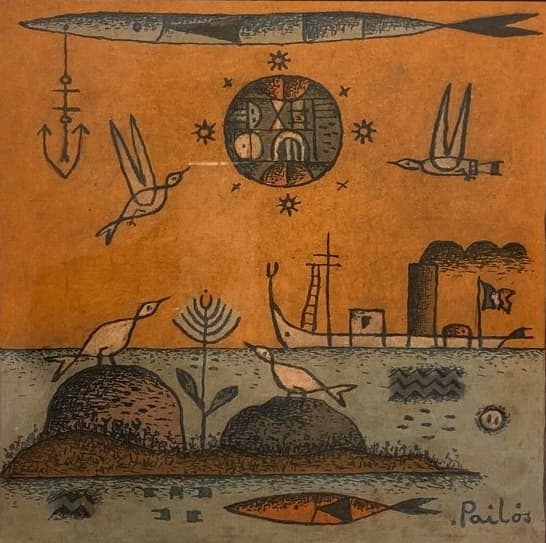
Manuel Pailós was a Spanish born painter whose career developed primarily in Latin America, where he became an important figure in the evolution of modern art in Uruguay. Born in 1918 in Spain, he relocated at a young age with his family to Montevideo, Uruguay, a move that would shape both his identity and his artistic trajectory. Over the course of his career, he developed a distinctive visual language that combined elements of constructivism, abstraction, and geometric structure, contributing to the broader movement of modern art in the region.
Pailós grew up in an environment influenced by both European traditions and the emerging cultural identity of Uruguay. He received his artistic training in Montevideo, where he came into contact with key ideas that would define his work. One of the most important influences on his development was the legacy of Joaquín Torres García, whose theory of constructivism emphasized order, proportion, and the integration of universal structure with local identity. While Pailós did not simply replicate this approach, it provided a conceptual framework that informed his early exploration of composition and form.
In his early work, Pailós engaged with figurative subjects, gradually simplifying forms and exploring structural relationships within the composition. Over time, his work moved increasingly toward abstraction. This transition reflected a broader shift taking place in mid twentieth century art, as artists sought new ways to express ideas through form, color, and spatial organization rather than direct representation.
Pailós became known for his disciplined approach to geometric abstraction. His compositions often feature carefully balanced arrangements of shapes, lines, and color fields. There is a strong sense of order in his work, with each element placed deliberately to create harmony and visual clarity. At the same time, his paintings are not rigid. Subtle variations in color and form introduce movement and rhythm, preventing the compositions from feeling static.
Color plays an essential role in his work. Pailós often used a controlled palette, combining warm and cool tones to create balance and contrast. His color relationships are carefully calibrated, contributing to the overall structure of the painting rather than serving as decorative elements. This approach reinforces the idea that color is an integral part of composition, working alongside line and form to define space.
Throughout his career, Pailós remained committed to a constructive vision of art, one that emphasizes clarity, balance, and coherence. His work reflects an ongoing interest in how visual elements can be organized to create meaning without relying on narrative. This places him within a broader international context of abstract art, while also connecting him to the specific cultural developments of Uruguay.
In addition to his work as a painter, Pailós was involved in teaching and artistic exchange, contributing to the development of younger artists and the wider cultural scene. His influence extended beyond his own work, helping to shape the understanding of abstraction in Uruguay and the region.
Manuel Pailós died in 2004. Today, he is remembered as an important contributor to Latin American modernism, particularly within the tradition of geometric abstraction. His work demonstrates how structure and simplicity can be used to create depth and complexity. Through careful composition and a sustained commitment to formal exploration, he developed a body of work that continues to be appreciated for its clarity, balance, and enduring visual strength.
Represented By
Artworks by Manuel Pailós