Agustín de Celis
Spain, b. 1932
Agustín de Celis is a Spanish painter born in 1932 whose work is associated with lyrical abstraction and a sustained exploration of color, light, and atmospheric space. Over the course of his career, he has developed a refined visual language that moves away from strict representation and toward a more contemplative and sensory approach to painting. His work is often described as poetic, emphasizing mood, balance, and subtle visual transitions rather than narrative or descriptive detail.
De Celis was born in Spain during a period marked by political tension and cultural restriction, conditions that shaped the development of many artists of his generation. He pursued formal studies in art in Spain, where he built a strong foundation in drawing and painting. While academic training provided technical discipline, he became increasingly interested in modern movements that challenged traditional approaches. As Spain gradually opened to broader artistic influences, de Celis absorbed ideas from European abstraction, particularly those that emphasized color as a primary means of expression.
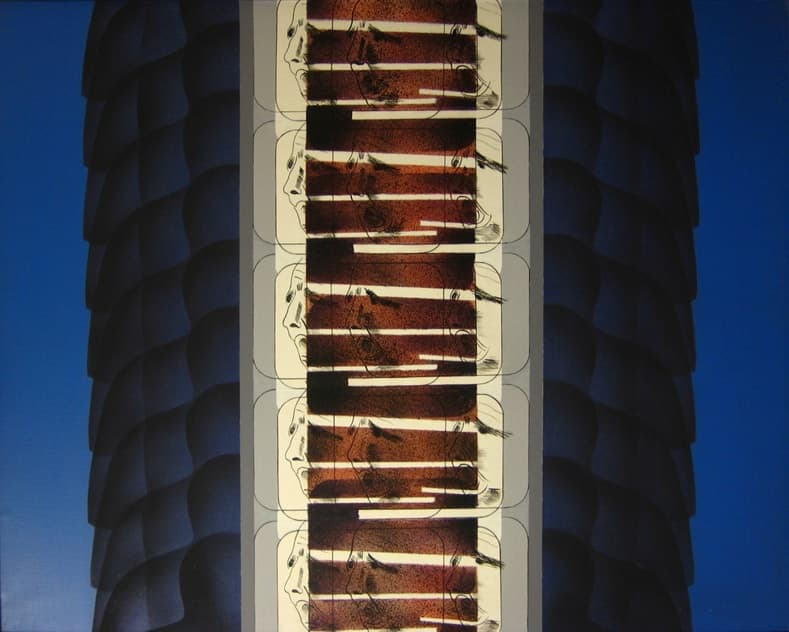
Throughout his career, de Celis has focused on the relationship between structure and atmosphere. His paintings often appear minimal at first glance, composed of layered color fields and soft transitions that suggest space without defining it explicitly. Rather than depicting objects or scenes, he constructs environments through color and light. These compositions invite quiet observation, encouraging the viewer to engage with the work over time.
Color is central to his practice. De Celis often works with restrained palettes, combining muted tones with occasional shifts in intensity to create depth and variation. His use of color is deliberate and controlled, with subtle gradations that produce a sense of movement across the surface. Light seems to emerge from within the painting, rather than being applied from an external source. This quality gives his work a sense of calm and continuity, as if the image exists in a suspended state.
Texture and layering also play an important role. His surfaces are built gradually, with multiple layers of paint that interact to create a sense of depth. This process oriented approach allows traces of earlier stages to remain visible, adding complexity without disrupting the overall harmony. The balance between simplicity and depth is one of the defining characteristics of his work.
Although his paintings are abstract, they often carry an underlying connection to landscape and natural phenomena. Viewers may sense horizons, skies, or expanses of space, even when these elements are not explicitly defined. This connection to the natural world gives his work a grounding presence, while its abstraction allows for open interpretation. The result is a body of work that feels both universal and personal.
De Celis has exhibited widely in Spain and internationally, contributing to the development of postwar abstraction. His work has been included in galleries and collections that focus on contemporary painting, and he has maintained a consistent presence within the art world over several decades. While he is not associated with a single movement, his work reflects broader trends in European abstraction that emphasize material, perception, and the experience of viewing.
Today, Agustín de Celis is regarded as an important figure in Spanish contemporary art. His paintings demonstrate how restraint and precision can create a powerful visual experience. By focusing on color, light, and space, he has developed a practice that invites reflection and sustained attention. His work continues to resonate with viewers drawn to subtlety and depth, offering a quiet but enduring contribution to abstract painting.
Represented By
Artworks by Agustín de Celis